Spring Quality & ScienceHot Spring Science
How Hot Springs Form: Water, Heat, and Pathways
How do hot springs emerge? This guide explains the 3 key conditions: water, heat, and pathways. Learn volcanic vs. non-volcanic springs, the geothermal gradient, and natural vs. drilled springs with clear diagrams.
Published: Dec 24, 2025
Spring Quality & ScienceHot Spring Science
How Hot Springs Form: Water, Heat, and Pathways
How do hot springs emerge? This guide explains the 3 key conditions: water, heat, and pathways. Learn volcanic vs. non-volcanic springs, the geothermal gradient, and natural vs. drilled springs with clear diagrams.
Published: Dec 24, 2025
Hot springs emerge when water that has seeped underground is heated and returns to the surface. It may look complex, but the basics are easy to understand if you think in terms of the three elements of water, heat, and pathways.
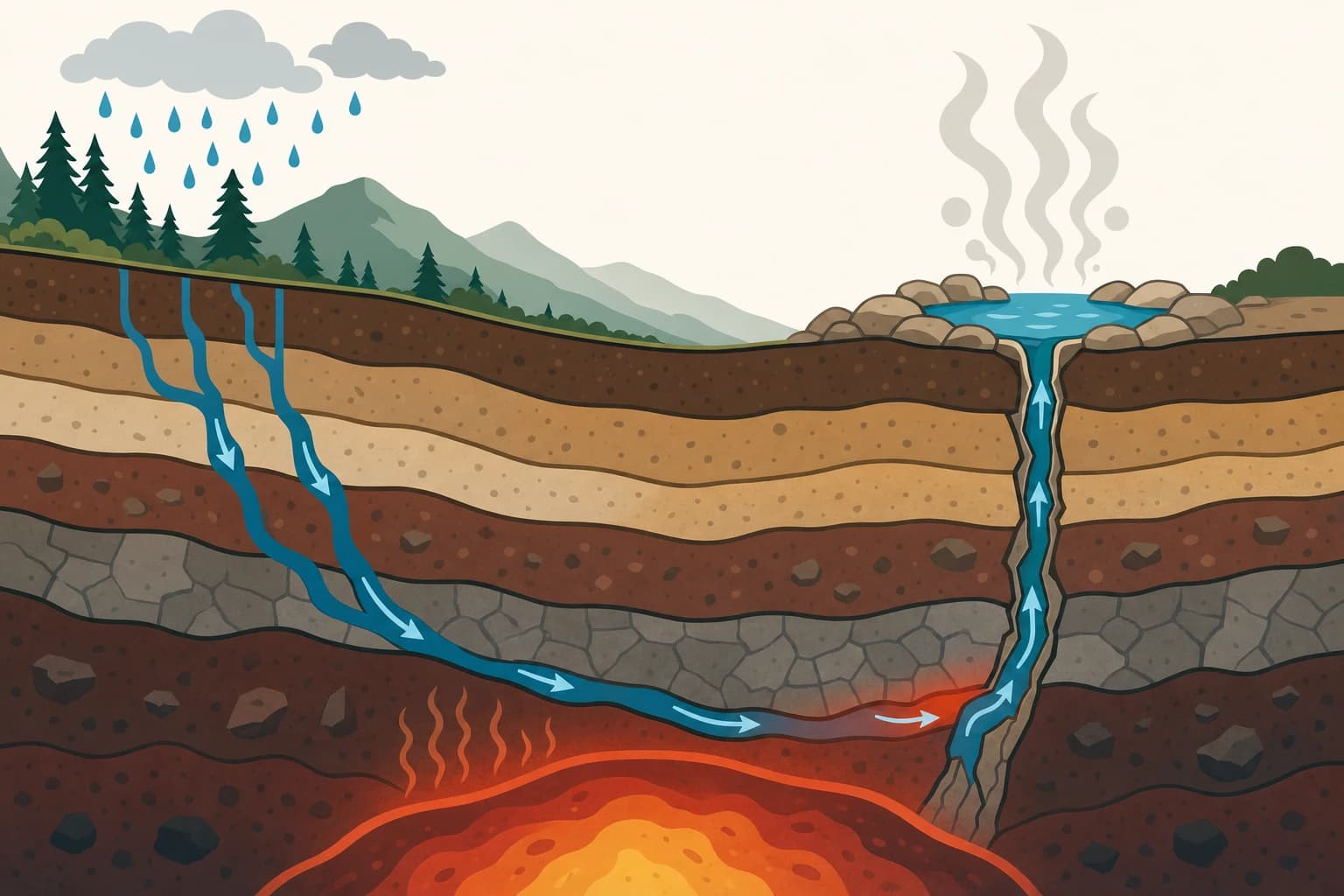
Rain and snow seep underground, are warmed by subterranean heat from magma or the geothermal gradient, then rise through cracks and faults to the surface.
In this article, we will organize the three conditions for hot springs to emerge, the differences between volcanic and non-volcanic hot springs, and the different ways they appear at the surface.
The 3 conditions for a hot spring to emerge
Three things are needed for a hot spring to emerge. If even one is missing, warm groundwater is unlikely to reach the surface.
- Water: In most cases, the source is rainwater or melted snow. It seeps into the ground and gradually becomes groundwater over a long period. Japan has abundant rainfall, so this condition is well met.
- Heat: The heat source that warms the groundwater. In areas near volcanoes, this comes from magma or volcanic heat. In non-volcanic areas, it is related to the fact that temperatures rise with depth inside the Earth.
- Pathways: Cracks and faults in bedrock that allow heated groundwater to return to the surface. This is why hot spring areas are often found along fault zones.
A closer look at the heat source: the geothermal gradient
The deeper you go underground, the higher the temperature becomes. In general, it is said to rise by 3°C per 100m, and this is called the geothermal gradient.
Many newly developed hot springs in areas without volcanoes use this geothermal gradient. Wells are drilled to around 1,500m, and water heated deep underground, known as deep groundwater, is pumped up. However, drilling alone does not guarantee success; abundant groundwater underground is essential.
Volcanic vs. non-volcanic hot springs
Hot springs can be broadly divided into two types based on their heat source.
| Main heat source | Typical look and smell | Example | |
|---|---|---|---|
| Volcanic hot springs | Magma and volcanic heat | Strong individuality such as sulfur smell and cloudy water | Kusatsu, Noboribetsu |
| Non-volcanic hot springs | Heat from deep underground (geothermal gradient) | Often milder in appearance but still mineral-rich | Deep hot springs in urban areas |
Volcanic hot springs often have distinctive smells and colors because ingredients such as sulfur are added. Non-volcanic hot springs, on the other hand, may look calm but still contain rich minerals. The relationship with volcanoes is explained in more detail in The Connection Between Volcanoes and Hot Springs. For a broader overview of spring types, see A Beginner’s Guide to Hot Spring Water Types.

The difference between natural and drilled springs
There is also a difference in how they reach the surface. A natural spring emerges on its own due to underground pressure, while a drilled spring is pumped up from a well.
Natural springs are often thought to be more valuable, but for travelers, the key point is not simply whether a spring is natural or drilled. What matters is the overall use of the source, including whether water is added or the bath is circulated, as well as the volume of water produced (The Difference Between Free-Flowing and Circulating Hot Springs).
Geysers and changes in how hot springs emerge
A hot spring that erupts at regular intervals is called a geyser. It is caused by pressure building underground and then being released all at once, and because it is easy to observe, it is popular. However, most hot springs emerge much more quietly.
Because hot springs are natural phenomena, their flow, temperature, and mineral content can also change. They may be affected by drilling, water usage, earthquakes, or crustal movement, so they do not remain exactly the same forever (How to Read Hot Spring Output Volume).
Frequently asked questions
Why do hot springs exist in places without volcanoes?
Because temperatures rise deeper underground (the geothermal gradient, about +3°C per 100m). Even without volcanoes, drilling deeper can sometimes reach heated groundwater.
What kind of water is hot spring water originally?
In many cases, it begins as rain or melted snow. It seeps into the ground, becomes groundwater over a long time, is heated, and then emerges.
Is a natural spring always better?
Not necessarily. More than whether it is natural or drilled, factors such as whether water is added, heated, or circulated, and the overall flow volume have a bigger impact on bathing quality.
Can hot springs run dry?
Yes. Hot springs are natural phenomena and are affected by usage and crustal movement. That is why careful management that protects the source is so important.
Summary
Hot springs emerge when water that has seeped into the ground is heated underground and returns to the surface through faults or cracks. The basics can be explained with the three elements of water, heat, and pathways. In Japan, there are both volcanic and non-volcanic hot springs, as well as natural and drilled springs. Understanding the mechanism makes it easier to appreciate the differences in minerals, smell, and how springs emerge when you visit a hot spring area.