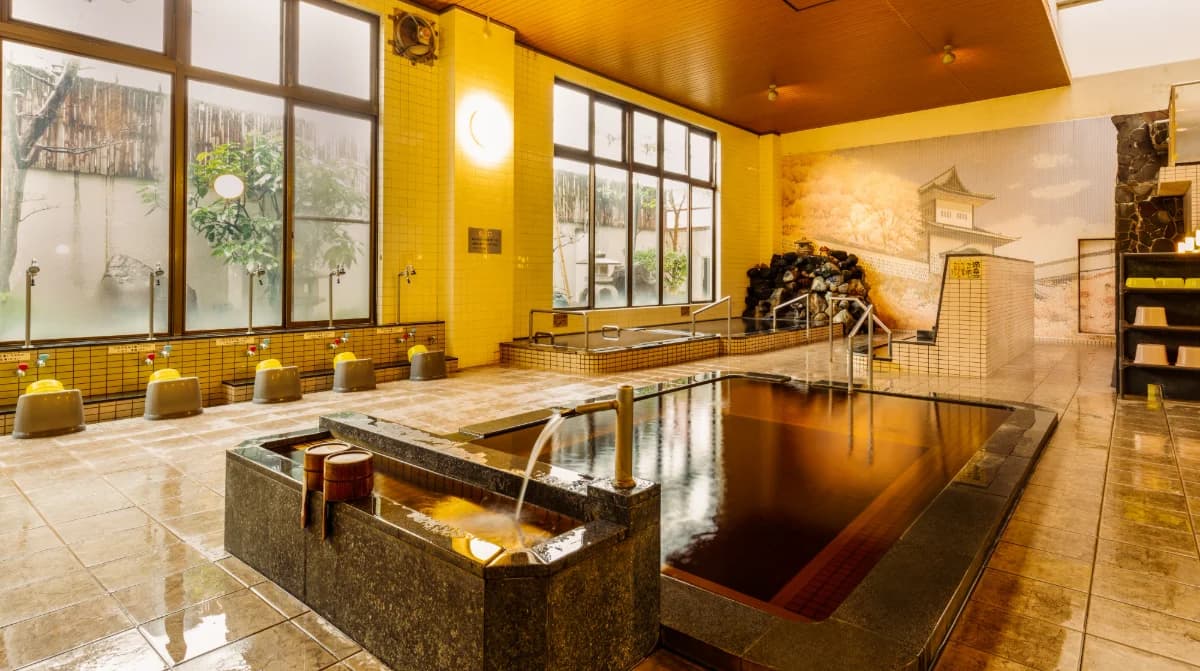
Hot springs that look golden, yellow-brown, or brown are visually distinctive and are often fondly called "golden waters." But there is no single reason why a bath may appear yellow or gold.
In short, there are multiple ingredients that can create a golden or yellow-brown color, and both the shade and the way it appears change depending on the cause. Iron oxidation, iodine oxidation, cloudy water with high salt content, pale-yellow sulfur deposits, and even plant-derived humic substances all play a role, making the background surprisingly diverse.
This article organizes the wide range of causes behind golden and yellow-brown waters, examples of famous baths called "golden waters," why the same spring can look different depending on conditions, and what to watch for when bathing. For the mechanism behind milky white water, see Why Milky Hot Springs Turn White; for a detailed explanation of why iron-rich springs turn reddish brown, see Why Iron-Rich Hot Springs Turn Reddish Brown. Here, we focus on yellow-to-golden appearances.
This article provides general information and does not guarantee specific health or beauty benefits. Dark-colored water may make the bottom hard to see and the surface slippery. If you have a chronic condition or are not feeling well, do not overdo it and follow the facility's guidance.
"Golden" describes appearance, not a spring type
First, it is important to note that "golden," "yellow-brown," and "brown" are not official spring classifications, but ways of describing how the water looks. Travel guides may present them with attractive names such as "golden waters," but that does not by itself indicate specific ingredients or effects.
Even within the same yellow range, a bright clear golden color, a cloudy yellow-brown, and a deep brown close to tea color may have different underlying causes. So when you see golden water, the best starting point is to ask, "What ingredient is causing this color?" The most reliable way to know is to check the spring analysis posted in the changing room or bathing area, not the appearance alone. For a broader overview of spring types, see Beginner's Guide to Hot Spring Types.
Main causes of golden and yellow-brown color
There are many reasons why water can look yellow to gold. Based on explanations from the Japan Spa Association and other sources, the main patterns are as follows. The colors are only general tendencies, and many waters contain several ingredients mixed together.
| Main cause | Typical appearance | What creates the color |
|---|
| Iron oxidation | Yellow-brown to reddish brown, or yellowish when faint | Iron oxidizes after exposure to air and turns into fine particles |
| Iodine oxidation | Pale yellow to light brown | Iodine in chloride springs oxidizes, often in seawater-based springs |
| Humic substances | Tea-colored to amber, as in moor springs | Plant-derived compounds dissolve in water as it passes through peat layers |
| Sulfur deposits | Milky white with a pale yellow tint | Sulfur compounds precipitate after exposure to air |
| Cloudy water with high salt content | Can become yellow-brown and cloudy | Mixing with iron and other components can cause turbidity |
Among these, iron oxidation is one of the most common reasons for a strong color. Water that was nearly clear underground comes into contact with air at the surface, causing iron to oxidize and form fine yellow-brown to reddish-brown particles that color the bath. If the iron content is relatively low, the water may look yellow to yellow-green; if it is higher, the color can deepen into brown. For a more detailed look at the chemistry behind reddish-brown iron-rich water, see Why Iron-Rich Hot Springs Turn Reddish Brown. Even in golden-looking water, iron is often involved.
Iodine is another important cause. In chloride springs sourced from seawater, water may emerge colorless but gradually turn pale yellow to light brown as iodide ions oxidize in contact with air. Springs containing iodine above a certain level are classified as medicinal springs called "iodine springs," and the Ministry of the Environment's mineral spring analysis guidelines define this as containing at least 10 mg of iodide ions per 1 kg of hot spring water.
Humic substances create a somewhat different type of color, but they are also widely known for producing yellow-brown to amber hot springs. Water that rises through peat layers can contain humic acids and other plant-derived organic matter formed over long periods of decomposition, giving it a tea or oolong tea color. The famous moor springs of Tokachigawa Onsen in Hokkaido are a typical example.
In addition, sulfur springs may have a pale yellow tint from sulfur deposits, and salty water can mix with other components to create cloudy yellow-brown baths. For more on sulfur-related white cloudiness and yellow tones, see The Smell and Color of Sulfur Springs.
Famous baths called "golden waters"
Golden and yellow-brown hot springs have long been cherished in many places as "golden waters" or "gold springs." Well-known examples all have iron as part of the color story.
At Arima Onsen in Hyogo Prefecture, the famous "Kinsen" contains a lot of iron and salt. It is nearly colorless when it first emerges, but turns reddish brown to gold as the iron oxidizes in contact with air. It is also known for its high salt content, and that character has long earned it the name "Kinsen."
Kogane-no-Yu at Ikaho Onsen in Gunma Prefecture also contains iron. It is colorless at the source, but turns tea-brown after exposure to air. This cloudy bath has been loved for a long time, and the fact that the same hot spring town also has a different source with a different color, including colorless water, shows well that appearance alone should not be used to judge a spring type.
These famous baths use the word "golden" to describe the impression of the color, not to promise any special effect. The safest approach is to check the posted spring type or the official analysis sheet to see exactly what kind of water it is.
Why the same water can look different
Golden and yellow-brown water can look different each time you visit. That is because many of the reactions that create the color progress after the water meets air.
Iron and iodine oxidation begin after the water reaches the surface and comes into contact with oxygen. As a result, water near the source outlet may still be fresh and nearly clear, while water farther from the outlet or water that has sat longer in the bath may look darker. The appearance also changes from day to day depending on the temperature, the water temperature, and the flow of the source, so it is not always the same color.
One common misunderstanding is the idea that "the darker the color, the richer the water" or "the deeper the color, the better the bath." Color intensity depends on how far oxidation has progressed and how many particles are suspended in the water, not directly on concentration or effect. Color is a clue to the water's character, but not a measure of quality.
Bathing cautions: staining and footing
There are a few practical points to keep in mind with golden and yellow-brown water.
First, water containing iron or pigments may stain white towels and clothing. If you can use the facility's rental towel, that is the best choice. If you bring your own white towel or swimsuit, be aware that discoloration may occur.
Second, in cloudy baths, the bottom and steps can be hard to see. In addition, oxidized iron and other substances may settle on the tub edge, floor, or around the outlet, creating a slippery surface. These baths can be visually striking, but it is best to move slowly and hold the edge or handrail when entering and leaving.
If the water is especially rich in minerals, start with a short soak rather than staying in too long. Splashing water over your body first to acclimate, then getting out before you feel overheated, remains the basic rule even for darker baths. If you want to compare facilities, start from the facility list.
Frequently asked questions
Why does hot spring water look golden or yellow-brown?
There is no single reason. The most common cause is iron oxidizing after exposure to air and becoming yellow-brown to reddish-brown fine particles. Other causes include iodine oxidizing in chloride springs sourced from seawater, which can make the water pale yellow to light brown, or humic substances such as humic acid, which create an amber tone. The color gives clues about what is in the water.
Is a "golden water" a hot spring with special benefits?
"Golden water" is a descriptive name for the color, not an official spring type. Springs like Kinsen at Arima or Kogane-no-Yu at Ikaho often have iron behind the color, but the name itself does not guarantee any specific effect. Check the posted spring type and the official analysis sheet for the actual characteristics.
Why is the source clear but the bath yellow?
Many of the reactions that create color, such as iron and iodine oxidation, progress after the water is exposed to air. Freshly emerged water has not oxidized much and stays nearly clear, but the longer it is exposed to air, the more it turns yellow or brown. The depth of color reflects how far oxidation has progressed, not how old the water is.
Does darker water mean stronger minerals and greater effects?
Not necessarily. Color intensity is determined by how far oxidation has progressed and how many particles are suspended, not directly by concentration or effectiveness. Color is only a clue to the bath's character and not a measure of superiority.
Is there anything to watch out for in yellow-brown baths?
Iron and pigments may stain white towels and clothing, so using the facility's towel or darker items can be safer. Cloudy water can make the bottom and steps hard to see, and deposits around the edges may make surfaces slippery. Move slowly in and out, and try mineral-rich baths with shorter soak times first.
Summary
Golden, yellow-brown, and tea-brown hot springs have a strong visual identity and are often cherished as "golden waters," but there is no single cause behind the color. Iron oxidation, iodine oxidation, cloudy high-salt water, pale yellow sulfur deposits, and humic substances from plants are all part of the picture. Famous baths such as Kinsen at Arima and Kogane-no-Yu at Ikaho are examples where iron shapes the color.
As a traveler, it helps to remember that color is a clue to the spring's character, not a measure of its benefits; that the appearance can change because the color develops after exposure to air; and that you can enjoy these baths safely if you pay attention to staining and footing. For the mechanism behind milky white water, see Why Milky Hot Springs Turn White; for a detailed explanation of iron causing reddish brown water, see Why Iron-Rich Hot Springs Turn Reddish Brown; and for a broader overview of spring types, see Beginner's Guide to Hot Spring Types.
Sources