Basic Knowledge and IntroductionUnderstanding Hot Spring Culture
Why Go to Hot Springs When You Have a Bath at Home?
If you already have a bath at home, why do Japanese people still go to hot springs or public baths? Learn the different roles of daily bathing, travel, rest, and shared culture.
Published: Apr 12, 2026
Basic Knowledge and IntroductionUnderstanding Hot Spring Culture
Why Go to Hot Springs When You Have a Bath at Home?
If you already have a bath at home, why do Japanese people still go to hot springs or public baths? Learn the different roles of daily bathing, travel, rest, and shared culture.
Published: Apr 12, 2026
If you already have a bath at home, why do Japanese people still go out of their way to visit hot springs or public baths? The reason is that home baths and hot springs are both bathing, yet their roles are completely different. A home bath is a daily facility for washing, warming up, and resetting the day, while hot springs and public baths are shared spaces for rest, a break from routine, and travel-based culture.
In Japan, most homes have bathrooms, and many people have the habit of soaking in a tub at home. Even so, hot spring resorts become travel destinations, and neighborhood public baths still draw regular visitors. Whether a home has bathing facilities and whether someone goes to a hot spring are separate matters. This article organizes the differences between home baths, hot springs, and public baths from three perspectives: their role as daily facilities, their nature as non-everyday shared spaces, and the sense that they form a connected bathing culture.
How are home baths different from hot springs and public baths?
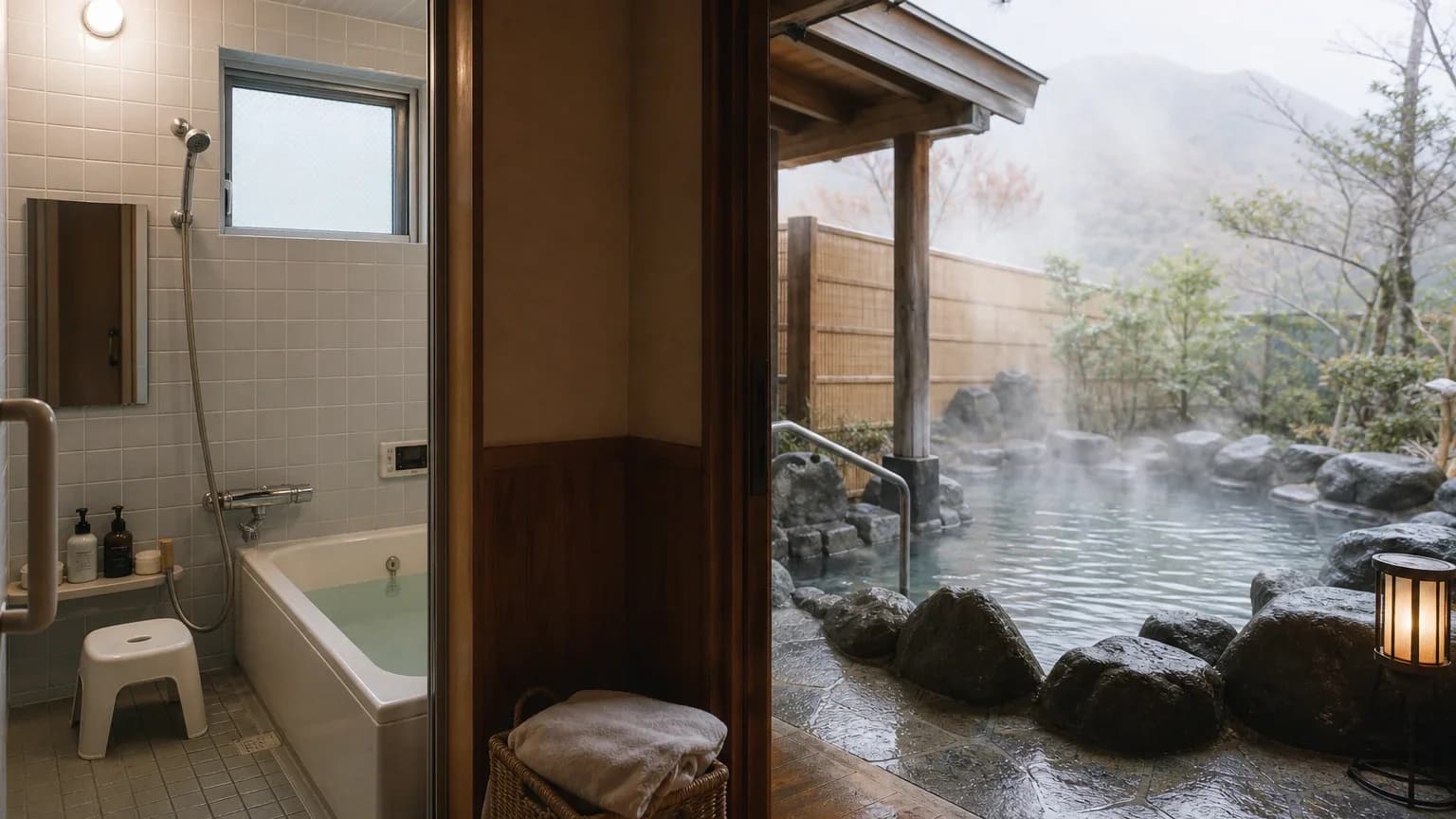
First, let us look at the whole picture in a table. Home baths and hot springs or public baths differ in purpose, space, how time is used, how clearly manners are defined, and the experiences that come with them.
| Perspective | Home Bath | Hot Springs / Public Baths |
|---|---|---|
| Main purpose | Wash, warm up, and reset the day | Rest, change pace, and enjoy travel |
| Space | Private space for family only | Shared space with others |
| Time use | Short time built into daily life | Non-everyday time that requires going out |
| Explicit rules | Flexible by household, few formal rules | Customs are clear, such as washing first and not putting towels in the water |
| Extra experiences | Mostly bathing only | Scenery, meals, hot spring towns, and seasonal atmosphere |
What this table shows is that the two should not be compared simply as better or worse facilities. A home bath is not inferior and a hot spring is not superior. Because their roles differ, hot springs still make sense even when you already have a bath at home.
Home baths are facilities that keep daily life running
A home bath is a facility that supports everyday life. It cleans the body, warms you up, and helps you settle down before sleep so that the day can end neatly. Its main role is part of daily routine.
In Japan, facilities that support this kind of everyday bathing are widely available. According to the Statistics Bureau’s explanation of the Housing and Land Survey, the share of homes with bathrooms is well over 90% nationwide, and nearly all newer homes have one. In other words, many households can soak in a tub at home.
What matters here is that in Japan, even home baths are strongly linked to the habit of soaking in a tub instead of just taking a shower. Soaking in hot water itself carries the meaning of warming up and resting. The background of why people soak in a tub almost every day is covered in the history of Japanese bathing culture. Home baths also offer relaxation, but only as bathing built into ordinary life, without going anywhere.
Hot springs and public baths are places for rest and non-everyday experiences
By contrast, hot springs and public baths are understood as places to spend time a little apart from everyday life. The act of bathing may be the same as at home, but the expected use of time is different. If a home bath is for keeping life moving, hot springs and public baths are for stepping away from life for a while.
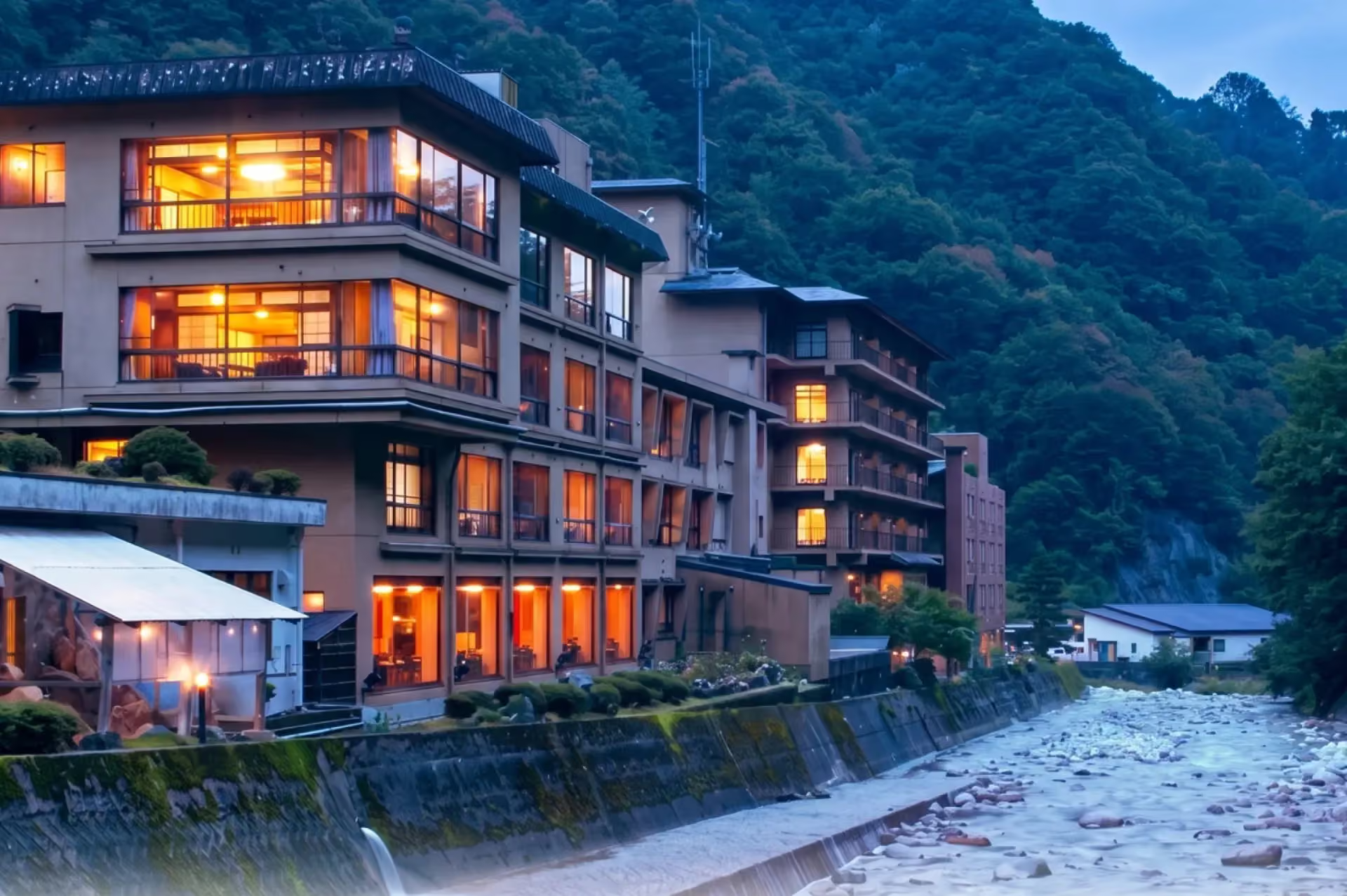
Especially at hot springs, the bathing itself is only part of the experience. The view from an open-air bath, the meals at the inn, walks through the hot spring town, and the seasonal atmosphere of the water all come together so that a hot spring is not just a place to bathe, but a travel destination in its own right. Tourism surveys also show that hot spring bathing ranks high among things inbound visitors want to do next, meaning the connection between travel and bathing is no longer unique to Japanese people.
Neighborhood public baths have the same structure in that some people still go even if they have a bath at home. The sense of freedom from stretching out in a large tub and the chance to switch off in a way that is hard to get at home are reasons to make the trip. Hot springs and public baths are separate systems, but that difference is explained in the difference between hot springs and public baths. The broader reason Japanese people love shared bathing spaces such as hot springs and saunas is summarized in why Japanese people love hot springs and saunas.

The biggest difference is whether the space is shared
The single biggest factor separating home baths from hot springs and public baths is who shares the space.
A home bath is a private space for family members only and is not meant to be shared with strangers. The order of use, washing habits, and how the bath water is used vary by household, and there is little need for formal written rules. An unspoken understanding within the family is enough.
Hot springs and public baths, on the other hand, are shared spaces where strangers use the same water. That is why customs such as washing your body before entering the tub, not putting towels in the water, and keeping quiet are clearly shared as part of the culture. This is less about stiff formality than about practical rules for keeping a shared bath clean and comfortable. Things you do not worry about at home are organized as culture in communal baths.
Among these customs, washing your body before entering the tub is one of the core rules that support communal bathing. Why this order matters is explained in detail in why you should wash before bathing. How urban public baths have functioned as shared spaces is covered in Tokyo hot spring and public bath culture.
Home baths and hot springs are also connected
So far, I have emphasized the differences, but home baths and hot springs are not completely separate worlds. In Japanese people’s sense of bathing, they are also closely linked.
For example, the order of washing first and then soaking, and the feeling that a tub is a place to warm the body and relax, are shared by both home baths and hot springs. Because soaking in a tub is already a familiar habit at home, the manners and comfort of hot spring bathing are also naturally understood. The sense learned through everyday bathing carries over directly into shared baths.
In other words, for Japanese people, hot spring culture has both a part that extends from home bathing habits and a part that developed as travel and shared-space culture. It is easier to understand if you see it as a two-layer structure: a foundation of soaking in water to reset the body, plus non-everyday elements such as travel, scenery, and togetherness.
Why do hot springs feel more special than home baths?
Even when there is a bath at home, hot springs feel special not because the water itself is necessarily different, but because hot springs add elements that cannot be experienced at home. Scenery, inns, hot spring towns, seasonal atmosphere, and time cut off from daily life all combine with bathing to make hot springs something worth traveling for.
Foreign travelers may find this two-sided nature hard to see because the everyday foundation of home bathing is invisible from the outside. For Japanese people, soaking in a bath at home is ordinary, and hot springs are enjoyed as a non-everyday experience on top of that. Once you understand the background of everyday bathing culture, the question of why people go to hot springs when they already have a bath at home becomes natural. If a home bath is where the day is reset, a hot spring is where you step away from daily life, and having both gives Japanese bathing culture its depth.
Frequently asked questions
Why do people go to hot springs if they already have a bath at home?
Because home baths and hot springs have different roles. A home bath is an everyday facility for washing and warming up, while a hot spring is a non-everyday rest and travel experience that includes scenery, meals, and hot spring towns. You can bathe at home as a facility, but the value of travel and a change of pace is much easier to find at a hot spring.
Do Japanese people soak in the tub every day?
Many people have the habit of soaking in a tub at home. The Statistics Bureau’s explanation of the Housing and Land Survey also shows that the share of homes with bathrooms is well over 90%. However, not everyone soaks every day, and some days are shower-only depending on the season and lifestyle. The trend is that many people place a value on soaking in hot water as a form of rest.
Are hot springs and public baths the same thing?
No, they are not the same. Hot springs use water that meets certain conditions as it rises from underground, and their value often centers on the spring quality and scenery. Public baths, by contrast, were originally community baths that support everyday bathing. The system-level differences are explained in the difference between hot springs and public baths.
Are the manners different at home baths and hot springs?
The biggest difference is whether the space is shared. A home bath is only for family, so customs vary by household. Hot springs and public baths are shared with others, so rules such as washing first, not putting towels in the water, and staying quiet are clearly established as culture.
Summary
Japanese people go to hot springs even though they have a bath at home because home baths and hot springs or public baths play different roles. A home bath is a daily facility for washing, warming up, and resetting the day, while hot springs and public baths are shared spaces for rest, a break from routine, and non-everyday culture tied to scenery and travel.
The two are not opposites; they are also connected. Because there is already a foundation of soaking in a tub at home, the manners and comfort of hot springs are naturally understood. To understand Japanese bathing culture, it is easier to look at both the shared sense and the different roles, rather than comparing home baths and hot springs as if they were completely separate.
Sources
- Statistics Bureau, Ministry of Internal Affairs and Communications, Housing and Land in Japan: Explanation of the 2008 Housing and Land Survey, 2-5 Housing Equipment
- Statistics Bureau, Ministry of Internal Affairs and Communications, Housing and Land Survey
- Japan Tourism Agency, Inbound Consumption Trend Survey (formerly Survey of Inbound Foreign Visitor Consumption Trends)