JAPAN ONSEN COLLECTION

When your heart unwinds,

The Finest Moment

A journey through 43 renowned hot springs and saunasJAPAN ONSEN & SAUNA GUIDE

Japan's Finest Onsen & Sauna

43 Extraordinary Destinations

43

A curator who has visited over 300 facilities nationwide handpicks 43 exceptional ones they wholeheartedly recommend. The only guidebook that deeply explores the allure of onsen and sauna—plus culture and etiquette.

Read a free preview
Japan Onsen & Sauna Guide
Find Sauna & Onsen FacilitiesOnsen & Sauna Guides

JAPAN ONSEN COLLECTION

When your heart unwinds,

The Finest Moment

A journey through 43 renowned hot springs and saunasJAPAN ONSEN & SAUNA GUIDE

Japan's Finest Onsen & Sauna

43 Extraordinary Destinations

43

A curator who has visited over 300 facilities nationwide handpicks 43 exceptional ones they wholeheartedly recommend. The only guidebook that deeply explores the allure of onsen and sauna—plus culture and etiquette.

Read a free preview
Japan Onsen & Sauna Guide

Find Facilities

  • Facility List
  • Search by Area
  • Featured Collections
  • Search by Onsen Area

Guides

  • Basic Knowledge and Introduction
  • The Appeal of Japan's Hot Springs and Saunas
  • Health & Benefits
  • Spring Quality & Science
  • Thematic Guides
  • Tips for a Successful Trip

Editor's Journal

  • Sauna & Onsen Trips

Support

  • Privacy Policy
  • Terms of Service
  • Commercial disclosure
  • Contact

© 2025-2026 Japan Onsen & Sauna Guide All rights reserved.

Unauthorized reproduction of content is prohibited.

Basic Knowledge and IntroductionUnderstanding Hot Spring Culture

Literary Giants and Hot Springs: Famous Onsen in Japanese Literature

From Natsume Soseki and Dogo Onsen to Yasunari Kawabata and Izu, and Naoya Shiga and Kinosaki Onsen, this guide accurately maps how modern Japanese literary masters connect with hot spring towns, and why they became settings for writing and healing.

Published: Jun 28, 2026

Basic Knowledge and IntroductionUnderstanding Hot Spring Culture

Literary Giants and Hot Springs: Famous Onsen in Japanese Literature

From Natsume Soseki and Dogo Onsen to Yasunari Kawabata and Izu, and Naoya Shiga and Kinosaki Onsen, this guide accurately maps how modern Japanese literary masters connect with hot spring towns, and why they became settings for writing and healing.

Published: Jun 28, 2026

  1. Home
  2. >Guide TOP
  3. >Basic Knowledge and Introduction
  4. >Understanding Hot Spring Culture
  5. >Literary Giants and Hot Springs: Famous Onsen in Japanese Literature

Table of Contents

  1. 1Natsume Soseki and Dogo Onsen
  2. 2Yasunari Kawabata and Izu
  3. 3Naoya Shiga and Kinosaki Onsen
  4. 4Other Literary Figures Connected to Hot Spring Towns
  5. 5Why Did Hot Spring Inns Become Places for Writing and Recuperation?
Basic Knowledge and IntroductionUnderstanding Hot Spring Culture

Literary Giants and Hot Springs: Famous Onsen in Japanese Literature

From Natsume Soseki and Dogo Onsen to Yasunari Kawabata and Izu, and Naoya Shiga and Kinosaki Onsen, this guide accurately maps how modern Japanese literary masters connect with hot spring towns, and why they became settings for writing and healing.

Published: Jun 28, 2026

Basic Knowledge and IntroductionUnderstanding Hot Spring Culture

Literary Giants and Hot Springs: Famous Onsen in Japanese Literature

From Natsume Soseki and Dogo Onsen to Yasunari Kawabata and Izu, and Naoya Shiga and Kinosaki Onsen, this guide accurately maps how modern Japanese literary masters connect with hot spring towns, and why they became settings for writing and healing.

Published: Jun 28, 2026

  1. Home
  2. >Guide TOP
  3. >Basic Knowledge and Introduction
  4. >Understanding Hot Spring Culture
  5. >Literary Giants and Hot Springs: Famous Onsen in Japanese Literature

Table of Contents

  1. 1Natsume Soseki and Dogo Onsen
  2. 2Yasunari Kawabata and Izu
  3. 3Naoya Shiga and Kinosaki Onsen
  4. 4Other Literary Figures Connected to Hot Spring Towns
  5. 5Why Did Hot Spring Inns Become Places for Writing and Recuperation?
6
How to Enjoy Literary Monuments and Associated Inns
  • 7Frequently Asked Questions
  • 8Summary
  • 9Sources
  • Modern Japanese literature contains many works set in hot spring towns. Natsume Soseki's Botchan is associated with Matsuyama, home to Dogo Onsen. Yasunari Kawabata's The Izu Dancer is set in the mountains of Izu. Naoya Shiga's At Kinosaki is tied to Kinosaki Onsen. In each case, the hot spring town is not just a backdrop. It was also a place where writers stayed for long periods, recovered their health, and sometimes wrote their works there.

    Why were hot springs so closely linked to literature? In short, hot spring towns were places to step away from daily life and rest body and mind, while also offering chances to meet people and observe local life. Spaces that satisfied both healing and observation were chosen not only as story settings but also as places to write. This article accurately organizes the relationships between major literary figures and hot spring towns, and traces the footprint hot springs left on Japanese literature.

    First, let's look at the overall picture through the most reliable connections.

    Literary figureMajor workAssociated hot spring townNotes
    Natsume SosekiBotchan (said to be 1906)Dogo Onsen (Matsuyama City)A hot spring appears in the story. Soseki was assigned to Matsuyama as a teacher
    Yasunari KawabataThe Izu Dancer (said to be 1926)Izu, Yugashima, AmagiNobel Prize-winning author. Based on his experience staying in Izu
    Naoya ShigaAt Kinosaki (said to be 1917)Kinosaki Onsen (Toyooka City)Based on his stay in Kinosaki for recuperation

    Among the work titles, settings, and dates, the dates are commonly known publication years, but in this article they are treated cautiously as "said to be." This is because the connections between literary figures and hot springs include both well-established facts and links preserved only through tradition or association. We will focus on the most verifiable correspondences.

    Natsume Soseki and Dogo Onsen

    In Natsume Soseki's signature work Botchan, hot springs are depicted vividly. The "Sumida no Yu" visited by the protagonist is widely understood to be modeled on Dogo Onsen in Matsuyama. Soseki himself was assigned to Matsuyama Middle School as an English teacher, and that experience is said to have formed the background of the work.

    Dogo Onsen continues to operate today as a public bath, with Dogo Onsen Honkan at its center, and it carefully preserves its connection to literature. The building itself is known as a symbol of onsen architecture, and its history and highlights are covered in detail in the Dogo Onsen guide. For more on the architectural value of the Honkan as an onsen building, see Onsen ryokan architecture.

    What is important here is that Botchan is set in a hot spring town, but it is not a work that praises hot springs like a tourist brochure. The hot spring is portrayed as part of the daily life of the place where the protagonist lives. In literature, hot spring towns often appear not as special sightseeing spots, but as places where people live.

    Yasunari Kawabata and Izu

    Yasunari Kawabata, who won the Nobel Prize in Literature, wrote The Izu Dancer, a delicate story about a student traveling through Izu and his gentle encounter with a young girl from a traveling performing troupe. The setting is the mountainous interior of the Izu Peninsula, and place names such as Yugashima and Amagi Pass are deeply tied to the story. Kawabata spent time in Izu when he was young, and that experience is said to form the foundation of the work.

    Izu has long been known as a hot spring region, with inns where literary figures stayed, such as Yugashima Onsen. On the same peninsula, Shuzenji Onsen is also well known as a place visited by many writers. The history and highlights of Shuzenji are covered in the Shuzenji Onsen guide.

    In The Izu Dancer, the hot spring town is portrayed as a place to stop along the journey and a place where people meet. Hot spring inns and public baths were also spaces where people of different social positions could casually cross paths. One reason literature favored hot spring towns was precisely this character as a place of encounter.

    Naoya Shiga and Kinosaki Onsen

    Naoya Shiga's At Kinosaki is a short story set in Kinosaki Onsen in Hyogo Prefecture. It is based on the author's experience of visiting Kinosaki for recuperation after an accident, and it is known as a quietly reflective work that contemplates life and death while staying in a hot spring town.

    Kinosaki Onsen is famous for its culture of visiting the town's public baths, and it continues to cherish its connection with literature. Literary monuments stand throughout the town, and Shiga's association is also part of the area's tourism story. How to enjoy Kinosaki Onsen and its public bath culture is covered in detail in the Kinosaki Onsen guide.

    At Kinosaki shows that hot spring towns were places for recuperation. The background is the culture of therapeutic bathing that has continued since before modern times, when people stayed in hot spring towns to heal their bodies. Shiga's stay can be seen as an extension of that tradition, suggesting that hot spring towns provided a place to quietly face oneself. The history of hot springs as healing places is explained in The history of bathing culture.
    Other Literary Figures Connected to Hot Spring Towns

    Beyond the cases where works and hot spring towns clearly correspond, such as Soseki, Kawabata, and Shiga, many other writers and poets stayed in hot spring towns or composed poems about them. However, because linking a specific work to a specific hot spring town requires strong evidence, we introduce them here with caution as figures associated with hot springs.

    The poet Akiko Yosano is known for traveling widely and leaving behind many poems, and poems said to have been composed in hot spring towns are also preserved. The novelist Osamu Dazai is said to have stayed in various hot spring inns, and inns associated with him are sometimes discussed. Fumiko Hayashi is also remembered as a writer who spent much of her life traveling and staying in many places, and her connection to hot spring towns is often mentioned.

    For these writers, there are often records that they "stayed" or "are said to have composed" works there, rather than firm one-to-one correspondences between a specific work and a specific setting. When talking about the connection between literary giants and hot springs, it is important to distinguish between verified correspondences and those that remain tradition or association. Reading the "associated with" guides provided by local inns and tourism associations with this nuance in mind will deepen your understanding.

    Why Did Hot Spring Inns Become Places for Writing and Recuperation?

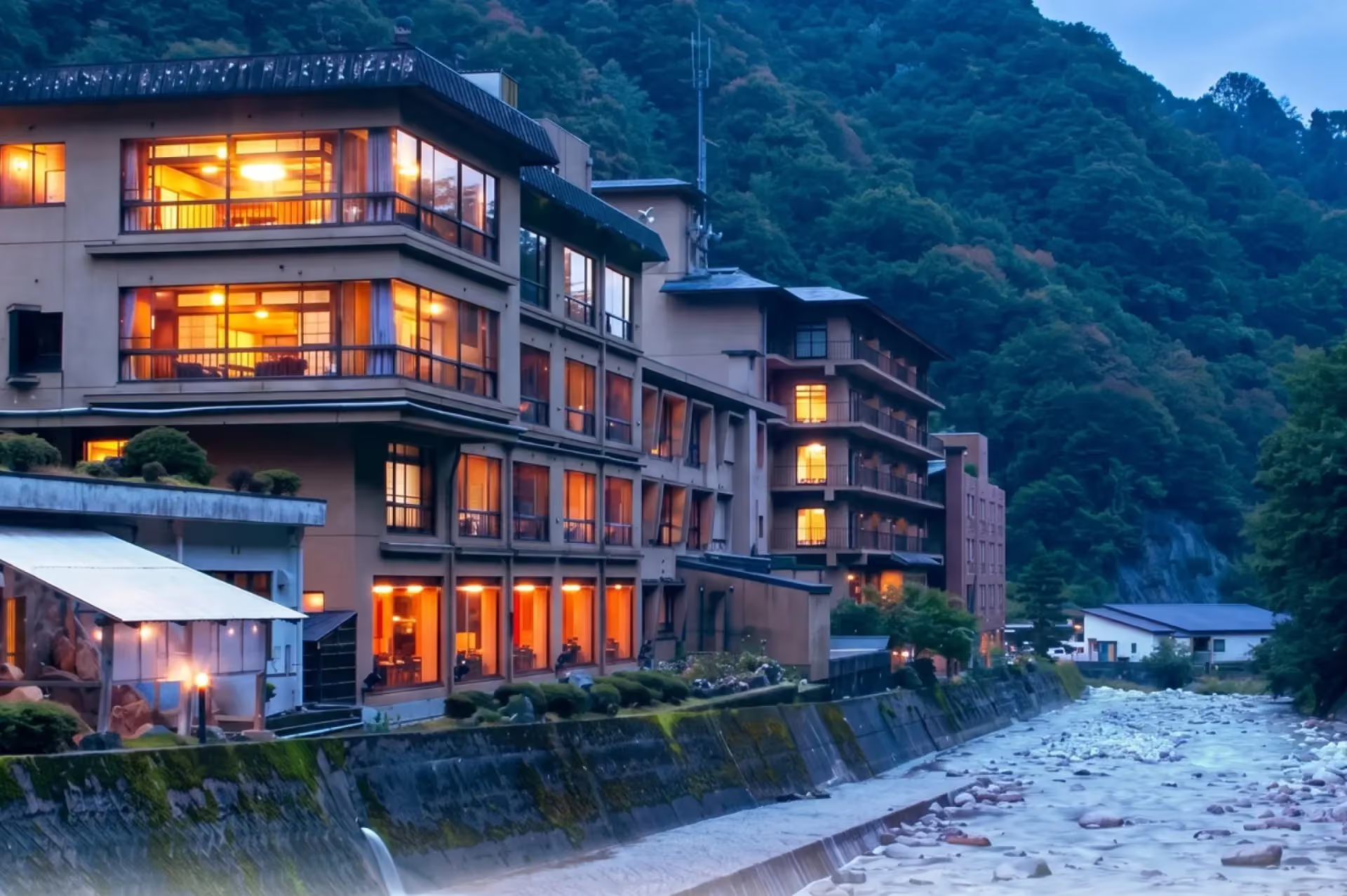
    The connection between literary figures and hot springs was supported by the nature of the inns themselves. Hot spring towns were away from cities, allowing people to step away from daily obligations. Many inns accepted long stays, making them suitable places to work quietly on manuscripts. Because the culture of therapeutic bathing was deeply rooted, stays of several weeks or even several months were not unusual.

    Hot spring inns were also places with a constant flow of people. Guests from many different regions, local daily life, and scenery that changed with the seasons all provided rich material for observation. The combination of quiet and stimulation made hot spring inns ideal for both writing and recuperation.

    The very design of these inns is closely tied to Japanese onsen architecture. The idea of shaping the bathing and lodging experience through guest rooms, corridors, window placement, and the relationship with the garden created an environment where writers wanted to remain for long periods. The concept of onsen architecture is organized in Onsen ryokan architecture.

    How to Enjoy Literary Monuments and Associated Inns

    When visiting a hot spring town associated with a literary figure, useful clues are literary monuments and associated inns. In hot spring towns such as Kinosaki, where monuments are placed around town, it is enjoyable to walk while reading passages from the work on site. In some cases, inns that are said to have hosted writers are still in operation, and their history is sometimes introduced by the inns themselves.

    At the same time, there is one thing to keep in mind. Guides that say "the room where the literary giant stayed" or "the bath connected to the work" may include both facts based on reliable records and traditions or legends. To enjoy these places without exaggeration, it is best to distinguish between verified correspondences and mere association, and to appreciate tradition as tradition. Even so, experiencing a hot spring town through literature gives the trip a depth that goes beyond the hot water itself.

    Frequently Asked Questions

    Where is the hot spring in Natsume Soseki's Botchan?

    It is generally considered to be Dogo Onsen in Matsuyama City. The "Sumida no Yu" in the story is widely understood to refer to Dogo Onsen, and Soseki's experience of being assigned to Matsuyama as a teacher is said to be part of the background. For more details, see the Dogo Onsen guide.

    Where is The Izu Dancer set?

    It is set in the mountainous interior of the Izu Peninsula, with place names such as Yugashima and Amagi Pass involved in the story. The author, Yasunari Kawabata, is said to have based the work on his experience of staying in Izu when he was young. Kawabata was awarded the Nobel Prize in Literature in 1968.

    Which hot spring is the setting for At Kinosaki?

    Kinosaki Onsen in Hyogo Prefecture. The work is based on Naoya Shiga's experience visiting Kinosaki for recuperation, and it is known as a short story that reflects on life and death in a hot spring town. The culture of Kinosaki Onsen is covered in the Kinosaki Onsen guide.

    Why did literary giants stay in hot spring towns?

    Because hot spring towns were places to rest body and mind away from daily life, and at the same time environments where writers could work quietly. Thanks to the culture of therapeutic bathing, many inns accepted long stays, and the steady flow of visitors also made hot spring towns rich sources of material for observation.

    How true are the claims about inns associated with literary figures?

    Some are based on reliable records, while others remain tradition or legend. There are clear correspondences, such as Soseki and Dogo, Kawabata and Izu, and Shiga and Kinosaki, but there are also cases transmitted in the form of "said to have stayed there." It is best to distinguish between verified correspondences and associations.

    Summary

    Japanese literature of the modern era contains many masterpieces set in hot spring towns. Natsume Soseki's Botchan is set in Matsuyama, home to Dogo Onsen. Yasunari Kawabata's The Izu Dancer is set in Izu. Naoya Shiga's At Kinosaki is set against Kinosaki Onsen. Hot spring towns served as places for recuperation, observation, and sometimes even writing itself.

    When enjoying the connection between literary figures and hot springs, it is important to distinguish between verified correspondences and those that remain tradition or association. If you then follow literary monuments and associated inns, you can experience a depth in hot spring towns that you would never see by soaking alone. The hot spring towns depicted in Japanese literature still invite visitors to step into the next chapter of the story.

    Sources

    • National Diet Library
    • Matsuyama City Official Tourism Site (Dogo Onsen)
    • Kinosaki Onsen Tourism Association
    Back to Articles

    Category

    Basic Knowledge and IntroductionUnderstanding Hot Spring Culture

    More in This Category

    • Ryokan Hospitality and Nakai Culture: A World of Selfless Care

      Jun 28, 2026

    • What Is Kaiseki in an Onsen Ryokan? 2-Meal Dining Culture

      Jun 28, 2026

    • Onsen Makeup & Skincare: When to Remove and Moisturize

      Jun 28, 2026

    • Glasses and Contacts in Hot Springs: Fogging, Damage, Infection Risks

      Jun 28, 2026

    • How to Tell Hot Spring Signs and Curtains Apart

      Jun 28, 2026

    See All

    Related Articles

    • Yuda Onsen Guide: White Fox Legend and Soft Hot Spring Waters

      Jun 28, 2026

    • Yubara Onsen Guide: Sand Bath and Top-Ranked Open-Air Bath

      Jun 28, 2026

    • Kotohira Onsen Guide: Kagawa Hot Spring Town by Kotohira-gu Shrine

      Jun 28, 2026

    6
    How to Enjoy Literary Monuments and Associated Inns
  • 7Frequently Asked Questions
  • 8Summary
  • 9Sources
  • Modern Japanese literature contains many works set in hot spring towns. Natsume Soseki's Botchan is associated with Matsuyama, home to Dogo Onsen. Yasunari Kawabata's The Izu Dancer is set in the mountains of Izu. Naoya Shiga's At Kinosaki is tied to Kinosaki Onsen. In each case, the hot spring town is not just a backdrop. It was also a place where writers stayed for long periods, recovered their health, and sometimes wrote their works there.

    Why were hot springs so closely linked to literature? In short, hot spring towns were places to step away from daily life and rest body and mind, while also offering chances to meet people and observe local life. Spaces that satisfied both healing and observation were chosen not only as story settings but also as places to write. This article accurately organizes the relationships between major literary figures and hot spring towns, and traces the footprint hot springs left on Japanese literature.

    First, let's look at the overall picture through the most reliable connections.

    Literary figureMajor workAssociated hot spring townNotes
    Natsume SosekiBotchan (said to be 1906)Dogo Onsen (Matsuyama City)A hot spring appears in the story. Soseki was assigned to Matsuyama as a teacher
    Yasunari KawabataThe Izu Dancer (said to be 1926)Izu, Yugashima, AmagiNobel Prize-winning author. Based on his experience staying in Izu
    Naoya ShigaAt Kinosaki (said to be 1917)Kinosaki Onsen (Toyooka City)Based on his stay in Kinosaki for recuperation

    Among the work titles, settings, and dates, the dates are commonly known publication years, but in this article they are treated cautiously as "said to be." This is because the connections between literary figures and hot springs include both well-established facts and links preserved only through tradition or association. We will focus on the most verifiable correspondences.

    Natsume Soseki and Dogo Onsen

    In Natsume Soseki's signature work Botchan, hot springs are depicted vividly. The "Sumida no Yu" visited by the protagonist is widely understood to be modeled on Dogo Onsen in Matsuyama. Soseki himself was assigned to Matsuyama Middle School as an English teacher, and that experience is said to have formed the background of the work.

    Dogo Onsen continues to operate today as a public bath, with Dogo Onsen Honkan at its center, and it carefully preserves its connection to literature. The building itself is known as a symbol of onsen architecture, and its history and highlights are covered in detail in the Dogo Onsen guide. For more on the architectural value of the Honkan as an onsen building, see Onsen ryokan architecture.

    What is important here is that Botchan is set in a hot spring town, but it is not a work that praises hot springs like a tourist brochure. The hot spring is portrayed as part of the daily life of the place where the protagonist lives. In literature, hot spring towns often appear not as special sightseeing spots, but as places where people live.

    Yasunari Kawabata and Izu

    Yasunari Kawabata, who won the Nobel Prize in Literature, wrote The Izu Dancer, a delicate story about a student traveling through Izu and his gentle encounter with a young girl from a traveling performing troupe. The setting is the mountainous interior of the Izu Peninsula, and place names such as Yugashima and Amagi Pass are deeply tied to the story. Kawabata spent time in Izu when he was young, and that experience is said to form the foundation of the work.

    Izu has long been known as a hot spring region, with inns where literary figures stayed, such as Yugashima Onsen. On the same peninsula, Shuzenji Onsen is also well known as a place visited by many writers. The history and highlights of Shuzenji are covered in the Shuzenji Onsen guide.

    In The Izu Dancer, the hot spring town is portrayed as a place to stop along the journey and a place where people meet. Hot spring inns and public baths were also spaces where people of different social positions could casually cross paths. One reason literature favored hot spring towns was precisely this character as a place of encounter.

    Naoya Shiga and Kinosaki Onsen

    Naoya Shiga's At Kinosaki is a short story set in Kinosaki Onsen in Hyogo Prefecture. It is based on the author's experience of visiting Kinosaki for recuperation after an accident, and it is known as a quietly reflective work that contemplates life and death while staying in a hot spring town.

    Kinosaki Onsen is famous for its culture of visiting the town's public baths, and it continues to cherish its connection with literature. Literary monuments stand throughout the town, and Shiga's association is also part of the area's tourism story. How to enjoy Kinosaki Onsen and its public bath culture is covered in detail in the Kinosaki Onsen guide.

    At Kinosaki shows that hot spring towns were places for recuperation. The background is the culture of therapeutic bathing that has continued since before modern times, when people stayed in hot spring towns to heal their bodies. Shiga's stay can be seen as an extension of that tradition, suggesting that hot spring towns provided a place to quietly face oneself. The history of hot springs as healing places is explained in The history of bathing culture.

    Other Literary Figures Connected to Hot Spring Towns

    Beyond the cases where works and hot spring towns clearly correspond, such as Soseki, Kawabata, and Shiga, many other writers and poets stayed in hot spring towns or composed poems about them. However, because linking a specific work to a specific hot spring town requires strong evidence, we introduce them here with caution as figures associated with hot springs.

    The poet Akiko Yosano is known for traveling widely and leaving behind many poems, and poems said to have been composed in hot spring towns are also preserved. The novelist Osamu Dazai is said to have stayed in various hot spring inns, and inns associated with him are sometimes discussed. Fumiko Hayashi is also remembered as a writer who spent much of her life traveling and staying in many places, and her connection to hot spring towns is often mentioned.

    For these writers, there are often records that they "stayed" or "are said to have composed" works there, rather than firm one-to-one correspondences between a specific work and a specific setting. When talking about the connection between literary giants and hot springs, it is important to distinguish between verified correspondences and those that remain tradition or association. Reading the "associated with" guides provided by local inns and tourism associations with this nuance in mind will deepen your understanding.

    Why Did Hot Spring Inns Become Places for Writing and Recuperation?

    The connection between literary figures and hot springs was supported by the nature of the inns themselves. Hot spring towns were away from cities, allowing people to step away from daily obligations. Many inns accepted long stays, making them suitable places to work quietly on manuscripts. Because the culture of therapeutic bathing was deeply rooted, stays of several weeks or even several months were not unusual.

    Hot spring inns were also places with a constant flow of people. Guests from many different regions, local daily life, and scenery that changed with the seasons all provided rich material for observation. The combination of quiet and stimulation made hot spring inns ideal for both writing and recuperation.

    The very design of these inns is closely tied to Japanese onsen architecture. The idea of shaping the bathing and lodging experience through guest rooms, corridors, window placement, and the relationship with the garden created an environment where writers wanted to remain for long periods. The concept of onsen architecture is organized in Onsen ryokan architecture.

    How to Enjoy Literary Monuments and Associated Inns

    When visiting a hot spring town associated with a literary figure, useful clues are literary monuments and associated inns. In hot spring towns such as Kinosaki, where monuments are placed around town, it is enjoyable to walk while reading passages from the work on site. In some cases, inns that are said to have hosted writers are still in operation, and their history is sometimes introduced by the inns themselves.

    At the same time, there is one thing to keep in mind. Guides that say "the room where the literary giant stayed" or "the bath connected to the work" may include both facts based on reliable records and traditions or legends. To enjoy these places without exaggeration, it is best to distinguish between verified correspondences and mere association, and to appreciate tradition as tradition. Even so, experiencing a hot spring town through literature gives the trip a depth that goes beyond the hot water itself.

    Frequently Asked Questions

    Where is the hot spring in Natsume Soseki's Botchan?

    It is generally considered to be Dogo Onsen in Matsuyama City. The "Sumida no Yu" in the story is widely understood to refer to Dogo Onsen, and Soseki's experience of being assigned to Matsuyama as a teacher is said to be part of the background. For more details, see the Dogo Onsen guide.

    Where is The Izu Dancer set?

    It is set in the mountainous interior of the Izu Peninsula, with place names such as Yugashima and Amagi Pass involved in the story. The author, Yasunari Kawabata, is said to have based the work on his experience of staying in Izu when he was young. Kawabata was awarded the Nobel Prize in Literature in 1968.

    Which hot spring is the setting for At Kinosaki?

    Kinosaki Onsen in Hyogo Prefecture. The work is based on Naoya Shiga's experience visiting Kinosaki for recuperation, and it is known as a short story that reflects on life and death in a hot spring town. The culture of Kinosaki Onsen is covered in the Kinosaki Onsen guide.

    Why did literary giants stay in hot spring towns?

    Because hot spring towns were places to rest body and mind away from daily life, and at the same time environments where writers could work quietly. Thanks to the culture of therapeutic bathing, many inns accepted long stays, and the steady flow of visitors also made hot spring towns rich sources of material for observation.

    How true are the claims about inns associated with literary figures?

    Some are based on reliable records, while others remain tradition or legend. There are clear correspondences, such as Soseki and Dogo, Kawabata and Izu, and Shiga and Kinosaki, but there are also cases transmitted in the form of "said to have stayed there." It is best to distinguish between verified correspondences and associations.

    Summary

    Japanese literature of the modern era contains many masterpieces set in hot spring towns. Natsume Soseki's Botchan is set in Matsuyama, home to Dogo Onsen. Yasunari Kawabata's The Izu Dancer is set in Izu. Naoya Shiga's At Kinosaki is set against Kinosaki Onsen. Hot spring towns served as places for recuperation, observation, and sometimes even writing itself.

    When enjoying the connection between literary figures and hot springs, it is important to distinguish between verified correspondences and those that remain tradition or association. If you then follow literary monuments and associated inns, you can experience a depth in hot spring towns that you would never see by soaking alone. The hot spring towns depicted in Japanese literature still invite visitors to step into the next chapter of the story.

    Sources

    • National Diet Library
    • Matsuyama City Official Tourism Site (Dogo Onsen)
    • Kinosaki Onsen Tourism Association
    Back to Articles

    Category

    Basic Knowledge and IntroductionUnderstanding Hot Spring Culture

    More in This Category

    • Ryokan Hospitality and Nakai Culture: A World of Selfless Care

      Jun 28, 2026

    • What Is Kaiseki in an Onsen Ryokan? 2-Meal Dining Culture

      Jun 28, 2026

    • Onsen Makeup & Skincare: When to Remove and Moisturize

      Jun 28, 2026

    • Glasses and Contacts in Hot Springs: Fogging, Damage, Infection Risks

      Jun 28, 2026

    • How to Tell Hot Spring Signs and Curtains Apart

      Jun 28, 2026

    See All

    Related Articles

    • Yuda Onsen Guide: White Fox Legend and Soft Hot Spring Waters

      Jun 28, 2026

    • Yubara Onsen Guide: Sand Bath and Top-Ranked Open-Air Bath

      Jun 28, 2026

    • Kotohira Onsen Guide: Kagawa Hot Spring Town by Kotohira-gu Shrine

      Jun 28, 2026