JAPAN ONSEN COLLECTION

When your heart unwinds,

The Finest Moment

A journey through 43 renowned hot springs and saunasJAPAN ONSEN & SAUNA GUIDE

Japan's Finest Onsen & Sauna

43 Extraordinary Destinations

43

A curator who has visited over 300 facilities nationwide handpicks 43 exceptional ones they wholeheartedly recommend. The only guidebook that deeply explores the allure of onsen and sauna—plus culture and etiquette.

Read a free preview
Japan Onsen & Sauna Guide
Find Sauna & Onsen FacilitiesOnsen & Sauna Guides

JAPAN ONSEN COLLECTION

When your heart unwinds,

The Finest Moment

A journey through 43 renowned hot springs and saunasJAPAN ONSEN & SAUNA GUIDE

Japan's Finest Onsen & Sauna

43 Extraordinary Destinations

43

A curator who has visited over 300 facilities nationwide handpicks 43 exceptional ones they wholeheartedly recommend. The only guidebook that deeply explores the allure of onsen and sauna—plus culture and etiquette.

Read a free preview
Japan Onsen & Sauna Guide

Find Facilities

  • Facility List
  • Search by Area
  • Featured Collections
  • Search by Onsen Area

Guides

  • Basic Knowledge and Introduction
  • The Appeal of Japan's Hot Springs and Saunas
  • Health & Benefits
  • Spring Quality & Science
  • Thematic Guides
  • Tips for a Successful Trip

Editor's Journal

  • Sauna & Onsen Trips

Support

  • Privacy Policy
  • Terms of Service
  • Commercial disclosure
  • Contact

© 2025-2026 Japan Onsen & Sauna Guide All rights reserved.

Unauthorized reproduction of content is prohibited.

Tips for a Successful TripChoosing Hot Springs by Region

How to Choose Family-Friendly Hot Spring Areas in Japan: Regions, Access, Lodgings

Planning a hot spring trip with kids? Choose regions with more family-friendly inns, easy access, and private family baths. This guide organizes area types and selection tips based on primary sources like JNTO.

Published: Apr 11, 2026

Tips for a Successful TripChoosing Hot Springs by Region

How to Choose Family-Friendly Hot Spring Areas in Japan: Regions, Access, Lodgings

Planning a hot spring trip with kids? Choose regions with more family-friendly inns, easy access, and private family baths. This guide organizes area types and selection tips based on primary sources like JNTO.

Published: Apr 11, 2026

  1. Home
  2. >Guide TOP
  3. >Tips for a Successful Trip
  4. >Choosing Hot Springs by Region
  5. >How to Choose Family-Friendly Hot Spring Areas in Japan: Regions, Access, Lodgings

Table of Contents

  1. 1Three axes for choosing a hot spring area with kids
  2. 2Regional map by area type
  3. 3Look at both total travel time from the city and the distance from station to inn
  4. 4Family baths and meals are easier to match in regions with many inns
  5. 5Whether sightseeing fits in is also part of choosing a region
Tips for a Successful TripChoosing Hot Springs by Region

How to Choose Family-Friendly Hot Spring Areas in Japan: Regions, Access, Lodgings

Planning a hot spring trip with kids? Choose regions with more family-friendly inns, easy access, and private family baths. This guide organizes area types and selection tips based on primary sources like JNTO.

Published: Apr 11, 2026

Tips for a Successful TripChoosing Hot Springs by Region

How to Choose Family-Friendly Hot Spring Areas in Japan: Regions, Access, Lodgings

Planning a hot spring trip with kids? Choose regions with more family-friendly inns, easy access, and private family baths. This guide organizes area types and selection tips based on primary sources like JNTO.

Published: Apr 11, 2026

  1. Home
  2. >Guide TOP
  3. >Tips for a Successful Trip
  4. >Choosing Hot Springs by Region
  5. >How to Choose Family-Friendly Hot Spring Areas in Japan: Regions, Access, Lodgings

Table of Contents

  1. 1Three axes for choosing a hot spring area with kids
  2. 2Regional map by area type
  3. 3Look at both total travel time from the city and the distance from station to inn
  4. 4Family baths and meals are easier to match in regions with many inns
  5. 5Whether sightseeing fits in is also part of choosing a region
  • 6FAQ
  • 7Summary
  • 8Sources
  • When choosing a hot spring area with kids, it is better to look first at whether the region has many family-friendly inns, easy access from major cities, and plenty of private family bath options rather than at fame or spring quality. A famous hot spring area is not always family-friendly.

    The key points can be summarized into three areas. First, is it somewhere you can reach without strain from a major city such as Tokyo or Osaka? Second, can you easily find inns with private family baths, reserved baths, and meals suited to children? Third, are there enough inns to compare conditions and choose from? This article focuses on which region or hot spring area to choose and organizes how to identify family-friendly regions.

    Three axes for choosing a hot spring area with kids

    Traveling with children changes priorities compared with travel for adults only. Scenic views and spring quality are still important, but even more decisive are the burden of getting there, how the family will bathe together, and how easy meals are. Keeping the following three axes in mind when choosing a region makes it easier to avoid disappointment.

    The first is access. On trips with children, long travel time and complicated transfers directly lead to fatigue. A hot spring area that can be reached from your departure city, whether Kanto near Tokyo or Kansai near Osaka, with few transfers and a single limited express, is easier on everyone. It also matters whether the inn is close to the station or bus stop, or offers a shuttle. Even in the same hot spring area, a spa town with many inns near the station and a mountain inn 30 minutes away by car are completely different in terms of convenience for families.

    The second is whether it is easy for the whole family to bathe together. Because shared public baths in Japan are usually separated by gender, families who want to soak with small children should choose inns with private family baths, reserved baths, or open-air baths in the room. The more inns a region has with these options, the easier it is to find one that fits your needs. For how to book family baths themselves, see How to Book a Private Onsen Bath.

    The third is the number of accommodation options. When booking with children, the number of people, the children's ages, bedding, bath type, and meal style all require confirmation at once. In a hot spring area with many inns, you can compare these conditions and choose more carefully. In regions with only a few inns, even if the atmosphere is appealing, family-friendly conditions may not be available.

    Regional map by area type

    Hot spring areas suitable for families with children can be broadly divided into three types. The table below summarizes each type's typical access, ease of finding family-friendly inns, and the kind of family it suits. The place names are only examples, and conditions can vary greatly even within the same hot spring area depending on the inn. Travel times are approximate from major stations in major cities to the hot spring area and will vary depending on the train and time of day.

    Area typeExamplesApproximate access from major citiesEase of finding family-friendly innsBest for
    Urban-adjacentHakone, Atami, Kinugawa, etc.About 1.5-2 hours from Tokyo, mainly by limited expressHigh. Easy to compare inns with private family baths and in-room bathsFirst hot spring trip, families wanting short travel, one-night weekend stays
    Resort-styleNanki Shirahama, etc.About 2-2.5 hours from Osaka by limited expressHigh. Easy to choose large inns and lodgings with leisure facilitiesFamilies wanting to combine sightseeing and leisure, longer stays
    Nature and activity-basedMountain or highland hot spring areas in generalOften half a day or more from major citiesVaries widely by region. Check conditions carefully for standalone innsFamilies accustomed to travel, those who value a quiet environment

    Urban-adjacent areas are often reachable from Tokyo or Osaka by a single limited express, and many inns are clustered near the station. Hakone is easily accessible, with about 90 minutes from Shinjuku to Hakone-Yumoto on the Odakyu Romancecar, and JNTO introduces it as one of Japan's leading hot spring resorts visited by many travelers each year. Kinugawa Onsen is also about 2 hours from Asakusa on a Tobu limited express, making it a common first choice for families who want to keep travel time short. For a more detailed regional guide, see Complete Guide to Hakone Onsen.

    Resort-style areas are characterized by the ease of combining hot springs with aquariums, theme parks, and other leisure activities, as well as coastal scenery. Nanki Shirahama is about 2.5 hours from Osaka on the limited express Kuroshio, and with nearby leisure facilities it is well suited to families who want to enjoy both hot springs and sightseeing in one trip. The travel time is a bit longer, but the options for how to spend time there are broader.

    Nature and activity-based areas are quiet mountain or highland hot spring destinations. They are appealing, but travel takes longer. For example, Kinosaki Onsen is popular as a hot spring town you can walk around in a yukata, but it takes about 2 hours and 40 minutes from Osaka on the limited express Kounotori, so the journey is not short (Complete Guide to Kinosaki Onsen). This type is best for families whose children are used to travel and who want to avoid too much walking after arrival.

    Look at both total travel time from the city and the distance from station to inn

    When comparing access to hot spring areas, do not look only at the time from a major city. Also check the transfer from the nearest station or bus stop to the inn. Even if a place is 2 hours away by limited express, a further 30 minutes or more by local bus or car can be a heavy burden for families with children.

    Useful criteria include whether the limited express runs directly to the hot spring area's station, how many transfers are needed, whether inns are clustered near the station, and whether the inn offers a shuttle. Urban-adjacent hot spring areas often meet these conditions, making them hard to miss for a first family trip. Nature and activity-based areas, on the other hand, often become more burdensome in the final stretch of travel, so it is reassuring to confirm the location of the inn and whether a shuttle is available before booking.
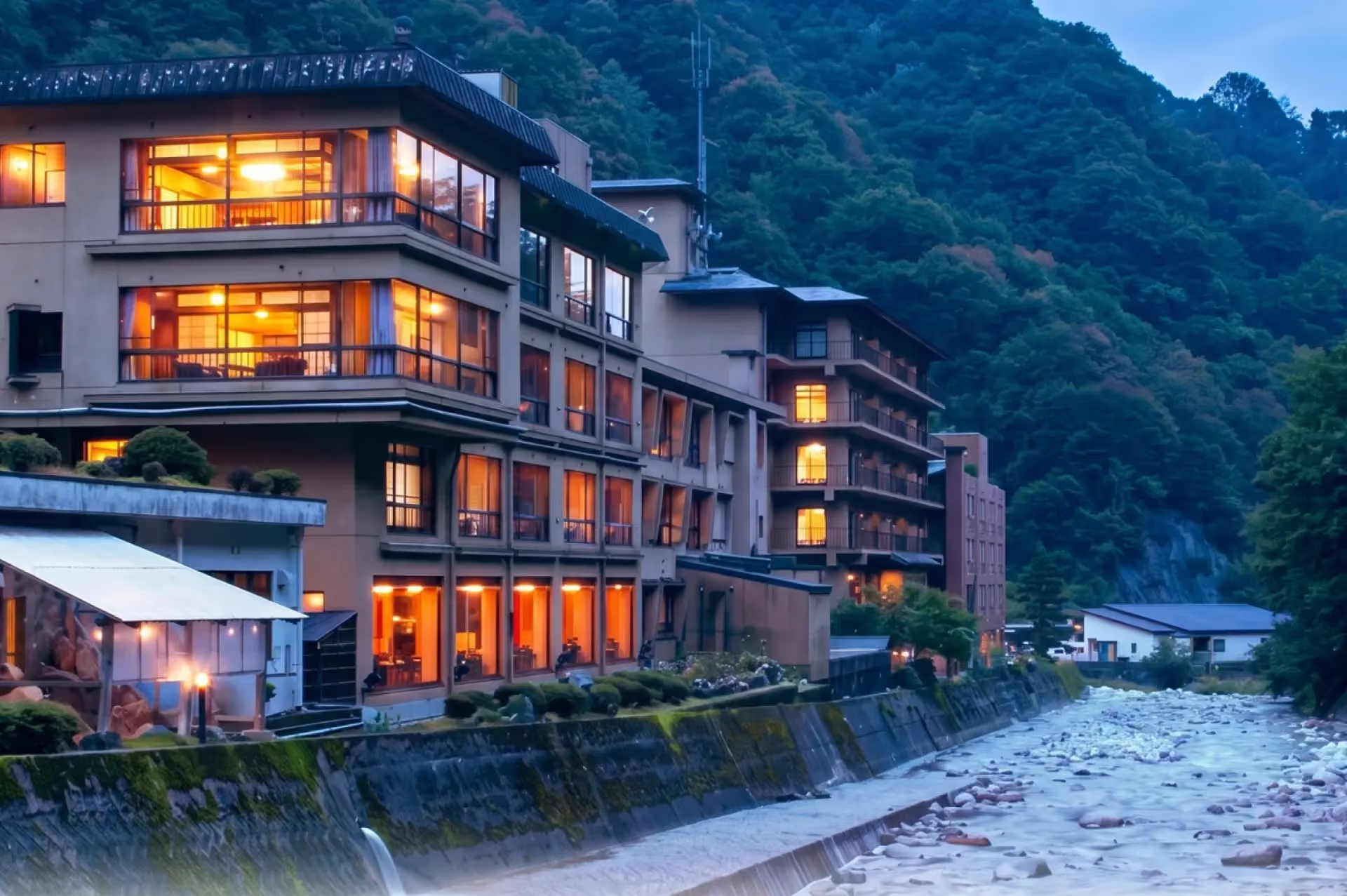
    Family baths and meals are easier to match in regions with many inns

    Whether a family can bathe together and whether children's meals are available depend more on each inn's conditions than on the region itself. That is precisely why areas with many inns to compare make it easier to find one that fits your needs.

    For bathing, you will want to look for inns with a private family bath, reserved bath, or open-air bath in the room. Urban-adjacent and resort-style hot spring areas have more inns, which makes it easier to compare facilities like these. For meals, inns that offer private dining rooms, in-room dining, children's menus, or flexible meal times are more comfortable for families. In Japanese ryokan, meals are a central part of the stay, so choosing based only on the bath can leave you struggling at mealtime. For concrete criteria, see How to Choose a Hot Spring Ryokan for Babies, and for how to combine family composition with bathing styles, see How to Choose Hot Springs for the Whole Family.

    Whether sightseeing fits in is also part of choosing a region

    For trips with children, satisfaction is often higher when hot springs are combined with nearby sightseeing or leisure rather than filling the whole day with bathing alone. It is useful to check in advance whether there are child-friendly attractions nearby or indoor facilities for rainy days.

    Resort-style hot spring areas are easy to combine with leisure facilities and sea or nature experiences. Urban-adjacent areas have the advantage of making it easy to add city sightseeing before or after the trip. Regions with more sightseeing options also make it easier to adjust plans depending on the weather or the child's condition.

    FAQ

    Which hot spring area is best for families with children?

    Rather than naming a single best place, it is safer to choose a region that is easy to reach from a major city, has many family-friendly inns, and has accommodations close to the station. If it is your first trip, urban-adjacent hot spring areas that can be reached from Tokyo or Osaka by a single limited express are strong candidates. If you want to combine the trip with sightseeing or leisure, a resort-style area is a good fit. Focus on how easy it is to use as a family trip rather than on the name of the place.

    From what age can children enter a hot spring?

    Age and safety guidelines are separate from regional selection and vary depending on the child's age in months, health, and the facility's rules. For details, see Basic Knowledge for Bathing in Hot Springs with Children. When choosing a region, priority should go to whether you can choose an inn with a private family bath.

    Can the whole family bathe in the same water even with children?

    Because shared public baths are usually separated by gender, families who want to bathe together should choose inns with a private family bath, reserved bath, or open-air bath in the room. These are more common in urban-adjacent and resort-style hot spring areas, where you can compare options more easily. For booking methods, see How to Book a Private Onsen Bath.

    How can I find a hot spring area with easy access?

    In addition to travel time from major cities, check whether there is a direct limited express, how many transfers are needed, the distance from the station to the inn, and whether the inn offers a shuttle. A hot spring area within 2 hours of a major city, with inns clustered near the station, is easier for families with children. Travel times can be checked on JNTO and the official websites of each hot spring area's tourism association.

    Should I avoid hot spring areas with only a few inns?

    Not necessarily, but you should confirm in advance whether family-friendly conditions are available. Areas with fewer inns can be quiet and appealing, but there may be limited options for private family baths or children's meals. If you can carefully check the conditions, nature and activity-based hot spring areas can still be good choices.

    Summary

    Hot spring areas suitable for families with children are those that are easy to reach from major cities, have many family-friendly inns, and make it easy to choose private family baths. Rather than fame or spring quality, it is less risky to choose based on practical factors such as ease of access, the number of lodging options, and whether the family can bathe together.

    Regions are easiest to understand when divided into three types: urban-adjacent, resort-style, and nature and activity-based. For a first family trip, urban-adjacent areas are strong candidates. If you want to combine the trip with sightseeing, resort-style areas are a better fit. Nature and activity-based areas are best chosen after checking travel and lodging conditions. Instead of deciding based only on the name of the place, it is recommended to narrow your choice by how easy it will be to use as a family trip.

    Sources

    • Japan National Tourism Organization (JNTO) "Hakone"
    • Japan National Tourism Organization (JNTO) Official Site, Travel Japan
    • Shirahama Onsen Ryokan Association "Access to Nanki Shirahama Onsen"
    • Visit Kinosaki (Kinosaki Onsen Tourism Association) "Getting Here"
    • Tobu Railway "Access Information for Nikko, Kinugawa Onsen, and Aizu"
    Back to Articles

    Category

    Tips for a Successful TripChoosing Hot Springs by Region

    More in This Category

    • Which Hakone Area Should You Stay In? Area-by-Area Guide

      Jun 28, 2026

    • Izu Hot Springs Guide: Coastal Peninsula Spots Near Tokyo

      Jun 28, 2026

    • Hokkaido Onsen Guide: Volcano, Snow & Lake Hot Springs

      Jun 28, 2026

    • Tohoku Hot Spring Guide: Top Hidden Baths by Prefecture

      Jun 28, 2026

    • Kyushu Hot Spring Guide: Top Prefectures and Routes

      Jun 28, 2026

    See All

    Related Articles

    • Yuda Onsen Guide: White Fox Legend and Soft Hot Spring Waters

      Jun 28, 2026

    • Yubara Onsen Guide: Sand Bath and Top-Ranked Open-Air Bath

      Jun 28, 2026

    • Kotohira Onsen Guide: Kagawa Hot Spring Town by Kotohira-gu Shrine

      Jun 28, 2026

  • 6FAQ
  • 7Summary
  • 8Sources
  • When choosing a hot spring area with kids, it is better to look first at whether the region has many family-friendly inns, easy access from major cities, and plenty of private family bath options rather than at fame or spring quality. A famous hot spring area is not always family-friendly.

    The key points can be summarized into three areas. First, is it somewhere you can reach without strain from a major city such as Tokyo or Osaka? Second, can you easily find inns with private family baths, reserved baths, and meals suited to children? Third, are there enough inns to compare conditions and choose from? This article focuses on which region or hot spring area to choose and organizes how to identify family-friendly regions.

    Three axes for choosing a hot spring area with kids

    Traveling with children changes priorities compared with travel for adults only. Scenic views and spring quality are still important, but even more decisive are the burden of getting there, how the family will bathe together, and how easy meals are. Keeping the following three axes in mind when choosing a region makes it easier to avoid disappointment.

    The first is access. On trips with children, long travel time and complicated transfers directly lead to fatigue. A hot spring area that can be reached from your departure city, whether Kanto near Tokyo or Kansai near Osaka, with few transfers and a single limited express, is easier on everyone. It also matters whether the inn is close to the station or bus stop, or offers a shuttle. Even in the same hot spring area, a spa town with many inns near the station and a mountain inn 30 minutes away by car are completely different in terms of convenience for families.

    The second is whether it is easy for the whole family to bathe together. Because shared public baths in Japan are usually separated by gender, families who want to soak with small children should choose inns with private family baths, reserved baths, or open-air baths in the room. The more inns a region has with these options, the easier it is to find one that fits your needs. For how to book family baths themselves, see How to Book a Private Onsen Bath.

    The third is the number of accommodation options. When booking with children, the number of people, the children's ages, bedding, bath type, and meal style all require confirmation at once. In a hot spring area with many inns, you can compare these conditions and choose more carefully. In regions with only a few inns, even if the atmosphere is appealing, family-friendly conditions may not be available.

    Regional map by area type

    Hot spring areas suitable for families with children can be broadly divided into three types. The table below summarizes each type's typical access, ease of finding family-friendly inns, and the kind of family it suits. The place names are only examples, and conditions can vary greatly even within the same hot spring area depending on the inn. Travel times are approximate from major stations in major cities to the hot spring area and will vary depending on the train and time of day.

    Area typeExamplesApproximate access from major citiesEase of finding family-friendly innsBest for
    Urban-adjacentHakone, Atami, Kinugawa, etc.About 1.5-2 hours from Tokyo, mainly by limited expressHigh. Easy to compare inns with private family baths and in-room bathsFirst hot spring trip, families wanting short travel, one-night weekend stays
    Resort-styleNanki Shirahama, etc.About 2-2.5 hours from Osaka by limited expressHigh. Easy to choose large inns and lodgings with leisure facilitiesFamilies wanting to combine sightseeing and leisure, longer stays
    Nature and activity-basedMountain or highland hot spring areas in generalOften half a day or more from major citiesVaries widely by region. Check conditions carefully for standalone innsFamilies accustomed to travel, those who value a quiet environment

    Urban-adjacent areas are often reachable from Tokyo or Osaka by a single limited express, and many inns are clustered near the station. Hakone is easily accessible, with about 90 minutes from Shinjuku to Hakone-Yumoto on the Odakyu Romancecar, and JNTO introduces it as one of Japan's leading hot spring resorts visited by many travelers each year. Kinugawa Onsen is also about 2 hours from Asakusa on a Tobu limited express, making it a common first choice for families who want to keep travel time short. For a more detailed regional guide, see Complete Guide to Hakone Onsen.

    Resort-style areas are characterized by the ease of combining hot springs with aquariums, theme parks, and other leisure activities, as well as coastal scenery. Nanki Shirahama is about 2.5 hours from Osaka on the limited express Kuroshio, and with nearby leisure facilities it is well suited to families who want to enjoy both hot springs and sightseeing in one trip. The travel time is a bit longer, but the options for how to spend time there are broader.

    Nature and activity-based areas are quiet mountain or highland hot spring destinations. They are appealing, but travel takes longer. For example, Kinosaki Onsen is popular as a hot spring town you can walk around in a yukata, but it takes about 2 hours and 40 minutes from Osaka on the limited express Kounotori, so the journey is not short (Complete Guide to Kinosaki Onsen). This type is best for families whose children are used to travel and who want to avoid too much walking after arrival.

    Look at both total travel time from the city and the distance from station to inn

    When comparing access to hot spring areas, do not look only at the time from a major city. Also check the transfer from the nearest station or bus stop to the inn. Even if a place is 2 hours away by limited express, a further 30 minutes or more by local bus or car can be a heavy burden for families with children.

    Useful criteria include whether the limited express runs directly to the hot spring area's station, how many transfers are needed, whether inns are clustered near the station, and whether the inn offers a shuttle. Urban-adjacent hot spring areas often meet these conditions, making them hard to miss for a first family trip. Nature and activity-based areas, on the other hand, often become more burdensome in the final stretch of travel, so it is reassuring to confirm the location of the inn and whether a shuttle is available before booking.

    Family baths and meals are easier to match in regions with many inns

    Whether a family can bathe together and whether children's meals are available depend more on each inn's conditions than on the region itself. That is precisely why areas with many inns to compare make it easier to find one that fits your needs.

    For bathing, you will want to look for inns with a private family bath, reserved bath, or open-air bath in the room. Urban-adjacent and resort-style hot spring areas have more inns, which makes it easier to compare facilities like these. For meals, inns that offer private dining rooms, in-room dining, children's menus, or flexible meal times are more comfortable for families. In Japanese ryokan, meals are a central part of the stay, so choosing based only on the bath can leave you struggling at mealtime. For concrete criteria, see How to Choose a Hot Spring Ryokan for Babies, and for how to combine family composition with bathing styles, see How to Choose Hot Springs for the Whole Family.

    Whether sightseeing fits in is also part of choosing a region

    For trips with children, satisfaction is often higher when hot springs are combined with nearby sightseeing or leisure rather than filling the whole day with bathing alone. It is useful to check in advance whether there are child-friendly attractions nearby or indoor facilities for rainy days.

    Resort-style hot spring areas are easy to combine with leisure facilities and sea or nature experiences. Urban-adjacent areas have the advantage of making it easy to add city sightseeing before or after the trip. Regions with more sightseeing options also make it easier to adjust plans depending on the weather or the child's condition.

    FAQ

    Which hot spring area is best for families with children?

    Rather than naming a single best place, it is safer to choose a region that is easy to reach from a major city, has many family-friendly inns, and has accommodations close to the station. If it is your first trip, urban-adjacent hot spring areas that can be reached from Tokyo or Osaka by a single limited express are strong candidates. If you want to combine the trip with sightseeing or leisure, a resort-style area is a good fit. Focus on how easy it is to use as a family trip rather than on the name of the place.

    From what age can children enter a hot spring?

    Age and safety guidelines are separate from regional selection and vary depending on the child's age in months, health, and the facility's rules. For details, see Basic Knowledge for Bathing in Hot Springs with Children. When choosing a region, priority should go to whether you can choose an inn with a private family bath.

    Can the whole family bathe in the same water even with children?

    Because shared public baths are usually separated by gender, families who want to bathe together should choose inns with a private family bath, reserved bath, or open-air bath in the room. These are more common in urban-adjacent and resort-style hot spring areas, where you can compare options more easily. For booking methods, see How to Book a Private Onsen Bath.

    How can I find a hot spring area with easy access?

    In addition to travel time from major cities, check whether there is a direct limited express, how many transfers are needed, the distance from the station to the inn, and whether the inn offers a shuttle. A hot spring area within 2 hours of a major city, with inns clustered near the station, is easier for families with children. Travel times can be checked on JNTO and the official websites of each hot spring area's tourism association.

    Should I avoid hot spring areas with only a few inns?

    Not necessarily, but you should confirm in advance whether family-friendly conditions are available. Areas with fewer inns can be quiet and appealing, but there may be limited options for private family baths or children's meals. If you can carefully check the conditions, nature and activity-based hot spring areas can still be good choices.

    Summary

    Hot spring areas suitable for families with children are those that are easy to reach from major cities, have many family-friendly inns, and make it easy to choose private family baths. Rather than fame or spring quality, it is less risky to choose based on practical factors such as ease of access, the number of lodging options, and whether the family can bathe together.

    Regions are easiest to understand when divided into three types: urban-adjacent, resort-style, and nature and activity-based. For a first family trip, urban-adjacent areas are strong candidates. If you want to combine the trip with sightseeing, resort-style areas are a better fit. Nature and activity-based areas are best chosen after checking travel and lodging conditions. Instead of deciding based only on the name of the place, it is recommended to narrow your choice by how easy it will be to use as a family trip.

    Sources

    • Japan National Tourism Organization (JNTO) "Hakone"
    • Japan National Tourism Organization (JNTO) Official Site, Travel Japan
    • Shirahama Onsen Ryokan Association "Access to Nanki Shirahama Onsen"
    • Visit Kinosaki (Kinosaki Onsen Tourism Association) "Getting Here"
    • Tobu Railway "Access Information for Nikko, Kinugawa Onsen, and Aizu"
    Back to Articles

    Category

    Tips for a Successful TripChoosing Hot Springs by Region

    More in This Category

    • Which Hakone Area Should You Stay In? Area-by-Area Guide

      Jun 28, 2026

    • Izu Hot Springs Guide: Coastal Peninsula Spots Near Tokyo

      Jun 28, 2026

    • Hokkaido Onsen Guide: Volcano, Snow & Lake Hot Springs

      Jun 28, 2026

    • Tohoku Hot Spring Guide: Top Hidden Baths by Prefecture

      Jun 28, 2026

    • Kyushu Hot Spring Guide: Top Prefectures and Routes

      Jun 28, 2026

    See All

    Related Articles

    • Yuda Onsen Guide: White Fox Legend and Soft Hot Spring Waters

      Jun 28, 2026

    • Yubara Onsen Guide: Sand Bath and Top-Ranked Open-Air Bath

      Jun 28, 2026

    • Kotohira Onsen Guide: Kagawa Hot Spring Town by Kotohira-gu Shrine

      Jun 28, 2026