Tips for a Successful TripFamily & Privacy
Pros and Cons of Rooms with Private Open-Air Baths
The appeal of rooms with private open-air baths is more than the view. The real value is the freedom to bathe anytime, as often as you like, and the privacy to relax on your own terms. Learn the key drawbacks before booking: higher rates, water that may not be natural hot spring water, and winter cold or insects. We also explain who they suit best and who should choose another option.
Published: Apr 20, 2026
Tips for a Successful TripFamily & Privacy
Pros and Cons of Rooms with Private Open-Air Baths
The appeal of rooms with private open-air baths is more than the view. The real value is the freedom to bathe anytime, as often as you like, and the privacy to relax on your own terms. Learn the key drawbacks before booking: higher rates, water that may not be natural hot spring water, and winter cold or insects. We also explain who they suit best and who should choose another option.
Published: Apr 20, 2026
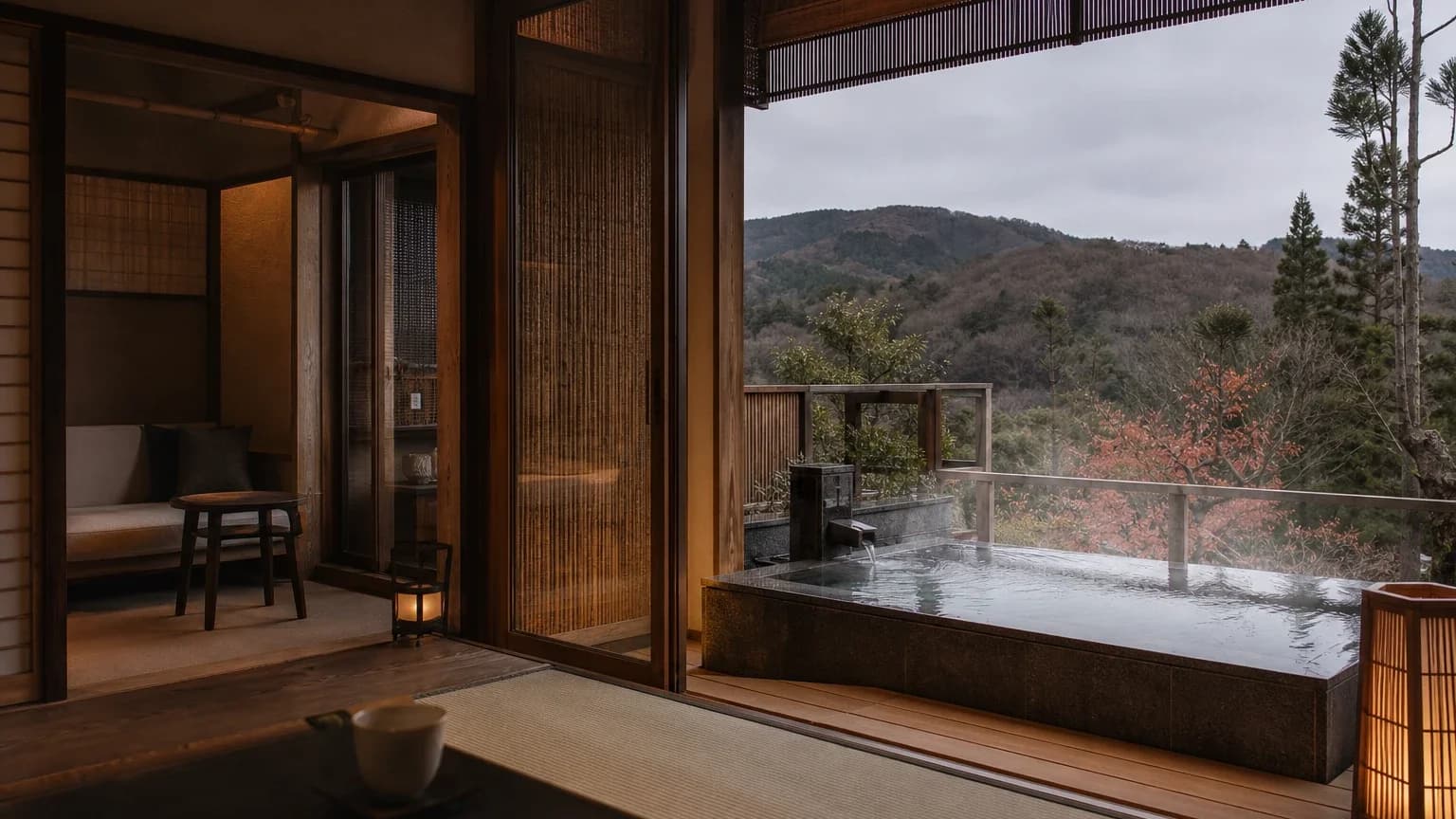
The value of a room with a private open-air bath is not just in the Instagram-worthy view. The real appeal is the freedom to bathe whenever you want, as often as you want, without being tied to public bath hours or other people’s eyes, plus the privacy to do so at your own pace. Whether it is early morning, late at night, or just five minutes after dinner, being able to step into your own bath whenever you feel like it is the biggest benefit.
That said, a room with a private open-air bath is not a perfect solution. It usually costs more than a standard room, the water is not always natural hot spring water, and there are practical downsides that come with being outdoors, such as cold weather, insects, and temperature control. This article organizes the appeal and benefits of private open-air baths themselves, the drawbacks and precautions that are easy to overlook, and what kinds of travelers they suit. For the practical side of how to find and book a room with a private open-air bath, see How to Choose Between Private Baths and Rooms with Open-Air Baths for Couples. For the full range of private bathing options, including reservable baths, see Hot Springs for People Who Dislike Being Naked: How to Choose Private Baths, Room Baths, and Swimwear Spas. This article focuses strictly on the pros and cons of rooms with private open-air baths.
The biggest value is freedom from fixed times
The most obvious advantage of a private open-air bath is that there is no time limit. Public baths have opening hours and cleaning periods, and private baths are often booked in forty-five- or sixty-minute slots. By contrast, a bath attached to your room can be used anytime during your stay, as often as you like.
This difference affects not just how many times you bathe, but the overall quality of the experience: not having to worry about the clock. You can wash off after check-in, cool down after dinner, take another bath before bed, and again in the morning when you wake up. That kind of routine is hard to achieve with a bath that has a fixed time slot. Because there is no need to think about transportation or reservations, it is much easier to shape your stay at a relaxed pace.
High privacy and the reassurance of bathing at your own pace
The second advantage is privacy. Crowded changing rooms, other guests’ eyes, getting ready in front of strangers—many of the stressful elements of public baths are essentially removed. Because everything happens inside your room, it is easier for people who feel uncomfortable being seen naked to use it. Families can take short baths that fit around a child’s mood or bedtime, and if you do not want to be naked in front of your companion, you can simply bathe at a different time. Since you do not need to worry so much about public bath etiquette, it can also be an easier entry point into Japanese hot spring culture.
Enjoy the scenery and the season from your own room
The third benefit is being able to make the view your own. The appeal of an open-air bath changes depending on location and season, as discussed in Open-Air Baths and Hot Spring Experiences in Nature, but a private open-air bath has a unique value in letting you enjoy that scenery from your own room without worrying about other guests. You can take in a valley, the sea, or a snowy landscape whenever you want, for as long as you want.
However, the presence and quality of the view differ from room to room. Some baths that look outdoor are actually semi-open-air, with walls or roofs limiting the view. If scenery is your main goal, checking the room type is essential.
A clear summary of benefits and precautions
The strengths and weaknesses of a private open-air bath are often two sides of the same coin. The table below shows general tendencies, but actual conditions vary widely depending on the inn and room type.
| Aspect | Benefit | Caution |
|---|---|---|
| Time | Use it anytime and as often as you like during your stay | None, freedom is almost purely an advantage |
| Privacy | Everything happens in your room, with no need to worry about being seen | Areas outside the room, such as dining venues, are a different matter |
| Scenery | Enjoy the view as if it were your own | Some semi-open-air rooms have limited views |
| Type of water | Some rooms draw natural hot spring water | Some use heated tap water and are not natural hot springs |
| Price | Overall satisfaction often feels higher | The room usually costs more than a standard room |
| Outdoor environment | You can feel the air and the season | Winter cold, summer insects, and the effort of temperature control |
As the table shows, freedom and privacy are almost pure benefits, but the type of water, price, and outdoor environment are points that require checking and acceptance. Below, we look at the cautions in more detail.
Caution 1: The water is not always natural hot spring water
One of the easiest points to overlook is that even if a room is advertised as having a private open-air bath, the water is not necessarily natural hot spring water. Under the Ministry of the Environment’s definition, a hot spring is water that gushes from underground and is at least 25 degrees Celsius, or water that meets the required dissolved-mineral standards. Water that is simply heated tap water is not a hot spring. The bath in a room may be heated water.
If natural hot spring water matters to you, be sure to distinguish between a room with hot spring water and a room with only a private open-air bath, and check the inn’s information carefully. Facilities that use hot spring water are expected to display whether the water is diluted, heated, circulated, filtered, or disinfected, and that can help you tell whether the water is truly natural hot spring water. For whether the source is used directly, see What Is Gensen Kakenagashi?.
Caution 2: The price tends to be higher
A private open-air bath often makes the room rate higher than a standard room in the same inn. Because you are reserving a dedicated facility, the higher price is only natural. The real question is whether your stay will make that difference worthwhile.
For travelers who mainly want to bathe and keep accommodation costs down, or for those who would be satisfied with a single use of a private bath, a room with a private open-air bath may feel expensive. On the other hand, people who want to bathe repeatedly without watching the clock, or who want a special stay for an anniversary or celebration, often feel that the experience is worth more than the price. The key question is not how many times you bathe, but whether you value freedom and privacy.
Caution 3: Cold weather, insects, and temperature management outdoors
There are also downsides that come from being an outdoor facility. In winter, your body can cool down quickly the moment you leave the bath. The Consumer Affairs Agency warns about bath-related accidents in winter and recommends warming the changing area and bathroom beforehand, keeping bathwater at 41°C or below, limiting bathing to about 10 minutes, and avoiding standing up suddenly. Even in a private open-air bath, the same temperature difference between indoors and outdoors applies, so the basic rule is to dry yourself before moving back inside.
In summer, insects are more common, especially mosquitoes and flying bugs in the evening, and their numbers can increase in rooms by rivers or in mountain areas. Private open-air baths also require you to check the water temperature before entering, and the water may cool down when not in use. Unlike a public bath that is kept at a steady temperature, it is not always ready at an ideal temperature. If you understand that it is affected by the season and outdoor conditions, you are less likely to feel disappointed.
How it differs from an open-air bath in a public bath
Even though both are called open-air baths, a public open-air bath and a private open-air bath have very different characteristics. In a public bath, the water volume, temperature, and cleaning are constantly managed, and a large tub is shared by many people. The openness is appealing, but time and privacy are still limited. A private open-air bath gives you freedom of space and time, but the tub is usually smaller, and temperature and cleanliness depend more on the room’s facilities. In other words, a public open-air bath is about using a large, well-managed bath together with others, while a private open-air bath is about using your own smaller bath whenever you want. For the broader context of facility types, see Types of Japanese Bath Facilities: How to Choose by Type.
Who it suits and who it does not
It suits people who value freedom and privacy. Those who feel uncomfortable being naked in front of others, families with children who need flexible bathing times, people who want to bathe multiple times, and travelers planning an anniversary or special trip are all likely to feel that the experience is worth the price.
By contrast, if your top priority is natural hot spring water and you want to keep accommodation costs down, or if you are comfortable with large public baths and would be satisfied with using a private bath once, then adding a private open-air bath is less essential. If you care more about the amount of water or the sense of openness, a public open-air bath may be more satisfying. The best choice depends on what you want from the bath. If you want to explore further, use Facility Listings to narrow your options by area or view, then check the photos and room details before deciding.
Frequently asked questions
What is the biggest advantage of a room with a private open-air bath?
The biggest advantage is freedom: you can use it anytime and as often as you like during your stay. Combined with the high privacy and the fact that you do not need to worry about being seen, this is considered a more essential value than the view itself.
Does a room with a private open-air bath always let me use hot spring water?
Not always. The water in the room may be heated tap water, in which case it is not a hot spring. Before booking, check whether it is a room with hot spring water and confirm the display or inn information about dilution, heating, circulation, and disinfection.
Can a private open-air bath be comfortable even in winter?
Yes, you can still enjoy the view, but you need to be careful about the sudden temperature difference when you get out. Choose a room with a warm changing area, dry yourself before returning indoors, and avoid staying in the bath too long.
Which is better: a public open-air bath or a private open-air bath?
Neither is universally better. If you want space, openness, and water that is constantly managed, a public open-air bath is a good fit. If you want freedom of timing and privacy, a private open-air bath is the better choice. Staying at a property that offers both can also be very comfortable.
Is a private open-air bath worth the higher price?
It is often worth it for people who want to bathe repeatedly or spend time without worrying about others or the clock. For travelers who only need one bath and want to keep the room rate down, it may feel expensive.
Summary
The essential value of a room with a private open-air bath is not the view itself, but the freedom to bathe as often as you like without being tied to time, and the privacy of not worrying about other people. It is especially well suited to families, people who dislike bathing in front of others, and travelers seeking a special stay.
At the same time, the room rate is usually higher than a standard room, the water is not always natural hot spring water, and there are outdoor drawbacks such as winter temperature swings, summer insects, and the effort of temperature control. If you check in advance whether the water is a hot spring, whether the bath is semi-open-air or fully outdoor, and whether the cost matches how you plan to use it, a private open-air bath is likely to be a highly satisfying choice.
