Thematic GuidesFamous Japanese Hot Springs
Sukayu Onsen Guide: Hiba Senninburo and Snowy Hakkoda
Explore Sukayu Onsen at the foot of Hakkoda in Aomori, known for Hiba Senninburo, a milky strong-acid sulfur spring, mixed bathing, women-only hours, heavy snow, and winter access tips.
Published: Jun 28, 2026
Thematic GuidesFamous Japanese Hot Springs
Sukayu Onsen Guide: Hiba Senninburo and Snowy Hakkoda
Explore Sukayu Onsen at the foot of Hakkoda in Aomori, known for Hiba Senninburo, a milky strong-acid sulfur spring, mixed bathing, women-only hours, heavy snow, and winter access tips.
Published: Jun 28, 2026
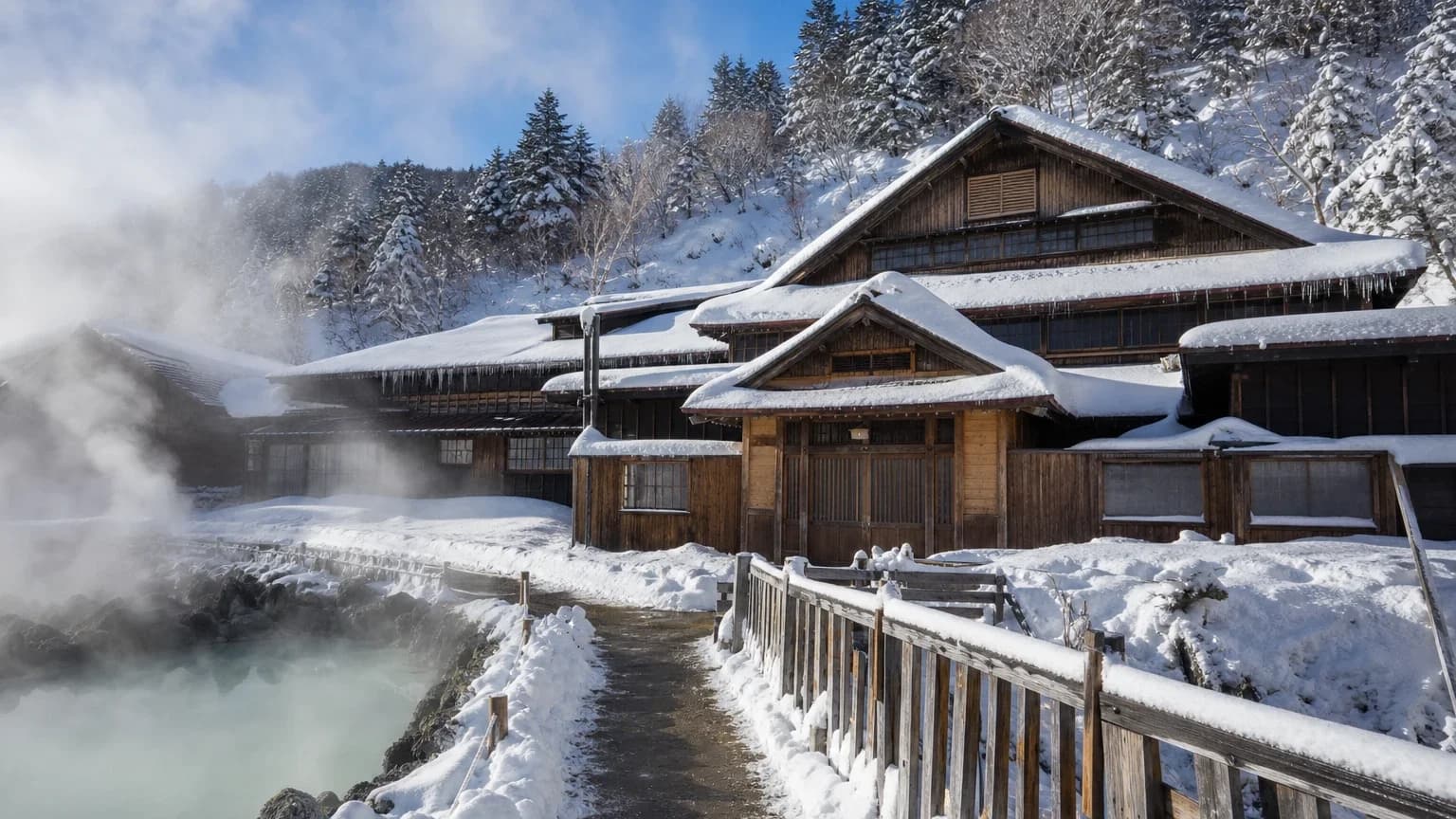
Sukayu Onsen is a one-inn hot spring resort in Aomori City, Aomori Prefecture, at the foot of Hakkoda and at an elevation of about 900m. It is known for Hiba Senninburo, a wide wooden public bath made entirely of Japanese cypress, and for its milky, strongly acidic sulfur spring. It is also famous for being in one of Japan’s heaviest snowfall areas. In the natural setting of Hakkoda, it is a hot spring area where you can soak while surrounded by snow.
In short, Sukayu Onsen’s appeal comes down to three points: Hiba Senninburo, built entirely of Japanese cypress, the milky strong-acid sulfur spring, and the heavy snow and nature of Hakkoda. The water is said to be a strongly acidic sulfur spring with a sharp tang, which is what creates the milky color, and it is a bath where you should also pay attention to skin irritation. This article explains what kind of hot spring area Sukayu Onsen is, what Hiba Senninburo is like, why the water is milky and strongly acidic, how mixed bathing works today, the heavy snow, snow-view bathing, and Hakkoda’s nature, as well as access from Aomori and Shin-Aomori and winter precautions, based on official tourism information for Sukayu Onsen and Aomori. For a scientific classification of spring types, see Onsen Spring Types for Beginners; here, we focus specifically on Sukayu Onsen.
This article provides general information and does not guarantee any specific health benefits or effects. Mixed bathing, women-only hours, bathwear rules, prices, bus timetables, and winter access are subject to change, and descriptions may differ between sources. Please check the official information before visiting. Because strongly acidic water can irritate the skin, keep bathing short and rinse with water before and after entering. Sulfur springs may produce hydrogen sulfide gas, so be sure to ventilate the bathing area and avoid staying inside for too long.
What kind of hot spring area is Sukayu Onsen?
Sukayu Onsen is located in a highland area in the southern part of Aomori City, Aomori Prefecture, at the foot of Hakkoda. Its elevation is said to be about 900m, and rather than a lively hot spring town, it has the feel of a one-inn resort set in Hakkoda’s natural surroundings. If you come expecting shopping streets and food-hopping, the impression will be quite different. It is easiest to understand as a hot spring area for those coming for the water, the nature, and the snow.
It is also known as an old therapeutic bathing site, and is sometimes introduced as one of the first National Health Hot Spring Resorts, designated in 1954. However, because the exact positioning of this “first” status varies by source, this article does not make a definite claim; please check official guides for the precise designation history. In any case, it is a hot spring area long cherished as a place for therapeutic bathing.
Because it is located at high elevation in a heavy snowfall zone, it changes dramatically with the seasons. In summer, it serves as a base for hiking and trekking in Hakkoda, while in winter it draws visitors who want to see some of Japan’s deepest snow and the famous snow monsters. A trip to Sukayu Onsen is not defined simply by “going there”; the season and purpose of the visit are the starting points for planning.
What is Hiba Senninburo?
The symbol of Sukayu Onsen is Hiba Senninburo, a large bath made entirely of Japanese cypress. The wooden hall, built with generous use of Aomori hiba cypress, is said to cover about 160 tatami mats. With multiple baths arranged in an open space with few pillars or partitions, it has a unique atmosphere wrapped in the texture of wood and rising steam. The abundance of hot water and the spaciousness of the room are the main attractions of this bath.
Hiba Senninburo has traditionally been known as a mixed bathing bath. However, whether women-only hours are available, whether bathwear is permitted, and how towels are handled may change depending on the season and the facility’s policy. If you are uneasy about mixed bathing, it is safest to check the official information in advance, including whether women-only hours or another bath is available. For clothing and etiquette when actually entering a mixed bathing onsen, see Mixed Bathing Onsen Today; first-time visitors may want to read that as well.
Because the water is a strongly acidic sulfur spring, bathing in Hiba Senninburo should also be kept short, with rinsing before and after entering. The bath is spacious and relaxing, so it is easy to stay too long, but because this is a strong water, it is wise to pay attention to your condition and bathe in moderation.
Why is the water milky and strongly acidic?
The water at Sukayu Onsen is said to be a milky, strongly acidic sulfur spring. The sulfur in the water turns into fine particles as air, temperature, and pressure change, scattering light and making the water look white and cloudy. At the same time, because it is strongly acidic, you may notice a sharp tang if you taste it, which is also reflected in the name Sukayu. The coexistence of milky whiteness and acidity is the easiest way to describe this spring’s character.
The mechanism behind milky water is explained in more detail in Milky White Onsen, while the white cloudiness and distinctive smell caused by sulfur are covered in Sulfur Onsen. Common characteristics of strongly acidic waters and how to bathe in them are summarized in Acidic Onsen. To understand Sukayu Onsen, it helps to remember that it combines three elements: milky water, sulfur, and strong acidity.
What matters most here is that strongly acidic water can be very irritating to the skin. Avoid long bathing sessions, keep your soak short, and use water to rinse and help your body adjust before and after entering. If you have sensitive skin or open wounds, do not push yourself; if you are unsure, it is better to avoid bathing or ask the facility. Also remember that whiteness or acidity does not directly indicate health benefits or quality. Sulfur springs may produce hydrogen sulfide gas, so be mindful of ventilation in the bath area as well.
Heavy snow, snow-view bathing, and Hakkoda’s nature
Another major feature of Sukayu Onsen is the heavy snowfall, said to be among the heaviest in Japan. Because it is located at the foot of Hakkoda, the area is covered in deep snow in winter, and many people visit to enjoy snow-view bathing, soaking while surrounded by snow. For how to enjoy a snow-view bath and what to watch out for in winter, see Snow-View Bathing.
There are also natural highlights around the area that are unique to Hakkoda. From summer to autumn, scenic marsh and pond landscapes such as Suiren-numa, which reflect the Hakkoda mountains, are well known. In winter, the snow monsters seen around the Hakkoda Ropeway are a signature sight. The appeal of this hot spring area is that it can be enjoyed together with Hakkoda’s nature in every season, not just the bath itself. However, whether you can travel to these spots and how long it takes depends greatly on the season, weather, and operating conditions, so check official information before making plans.
At the same time, being in a heavy snowfall area greatly raises the barrier to winter travel. Road conditions and bus service are affected by snowfall and icy roads, so if you are visiting in winter for snow-view bathing or snow monsters, you need to prepare your transport plans, equipment, and cold-weather gear carefully. It is best to think of Sukayu Onsen as a place whose character changes greatly with the seasons.
Quick guide to sights and combinations
Sukayu Onsen is often planned together with Hakkoda’s nature and nearby sights. Since all of them are at high elevation and access conditions change with the season and weather, you should consider travel possibilities as part of the plan. The quick table below summarizes Sukayu Onsen and the surrounding highlights by location, features, and approximate travel time. Please check the latest official information, as travel times and operating conditions vary greatly depending on route and season.
| Place | Features | Approx. time from Sukayu Onsen |
|---|---|---|
| Sukayu Onsen (inn and day-use bathing) | About 900m above sea level. Known for Hiba Senninburo and its milky strong-acid sulfur spring | Main base of the stay |
| Hiba Senninburo | A large bath made entirely of Japanese cypress, said to be about 160 tatami mats. Traditionally mixed bathing, though operation should be checked | Inside the building |
| Suiren-numa | Marsh and pond scenery reflecting the Hakkoda mountains. Best from summer to autumn | A few minutes by car or more, depending on season and road conditions |
| Snow monsters (around the Hakkoda Ropeway) | A winter specialty, strongly affected by operations and weather | Travel by car or bus, depending on winter conditions and route |
This table is only a rough guide, and travel in the area is strongly affected by weather and seasonal operations. Especially in winter, some roads and bus services may be restricted, so if you plan to visit multiple spots, it is best to check the operation calendar and road information first.
How to get there and how to get around
Aomori and Shin-Aomori are the main gateways to Sukayu Onsen. There are bus routes from Aomori Station and Shin-Aomori Station toward the foot of Hakkoda, but travel times, frequency, and operating periods vary greatly depending on the route, timetable, and season, so please check the latest official information. If you go by car, there is a mountain section leading up to the highlands, and in winter you must be prepared for snow and icy roads.
One thing to note is that Sukayu Onsen is in one of Japan’s heaviest snowfall areas, so access is often restricted in winter. Road conditions and bus service are affected by snowfall, and in some seasons routes and time windows are limited. Although winter offers the enjoyment of snow-view bathing and snow monsters, it is also a season when getting there becomes harder. If you are worried about access or visiting for the first time, choosing a period when service is more stable will make planning easier.
It is also popular to combine the trip with Hakkoda’s nature, but travel conditions change easily by season. Rather than trying to pack in too much, it is better to secure time to slowly soak in the milky water at Sukayu Onsen, which lets you enjoy what makes this hot spring area special. If you are looking for Sukayu Onsen or nearby bathing facilities, we also provide a facility list that lets you filter by area and conditions.
Who is it best for?
Sukayu Onsen is ideal for people who value the atmosphere of a historic therapeutic bathing site more than convenience, those who want to fully enjoy a large Japanese cypress bath and a milky strong-acid sulfur spring, and those who want to spend quiet time in Hakkoda’s natural surroundings. Enjoying snow-view bathing surrounded by snow, Suiren-numa in summer, and snow monsters in winter is a uniquely memorable experience here. On the other hand, if you expect a lively hot spring town or easy access, the remote location and seasonal restrictions may feel inconvenient.
If this is your first visit, it is better to sort out in advance the seasonal accessibility, the mixed-bathing and women-only-hour arrangements, and whether your skin can tolerate a strongly acidic spring, rather than judging only by the milky water or sharp taste. If you want to compare famous hot springs across Japan, see Japan’s Famous Onsen Ranking as well.
FAQ
Is Hiba Senninburo a mixed bathing bath?
Hiba Senninburo is traditionally known as a mixed bathing bath. However, whether women-only hours are available and whether bathwear is permitted may change by season and depend on the facility’s policy. If you are uneasy about mixed bathing, be sure to check the official information before visiting, including whether women-only hours or another bath is available. Clothing and etiquette for actually entering a mixed bathing bath are summarized in Mixed Bathing Onsen Today.
What kind of spring type is Sukayu Onsen?
It is considered a milky strong-acid sulfur spring. The sulfur in the water becomes fine particles that make the water cloudy white, and because it is strongly acidic, you may feel a sharp tang. Strongly acidic water can irritate the skin, so keep bathing short and rinse with water before and after entering. You can check the mechanism in Milky White Onsen, Sulfur Onsen, and Acidic Onsen.
What should I watch out for with a strongly acidic bath?
Because strongly acidic water can irritate the skin, avoid long bathing sessions and keep your soak short. It is also helpful to rinse with water before and after entering so your body can adjust and rinse off the water afterward. If you have sensitive skin or wounds, do not overdo it; if you are worried, avoid bathing or ask the facility. Sulfur springs may produce hydrogen sulfide gas, so pay attention to ventilation in the bath area and move away if you feel unwell.
Is Sukayu Onsen one of the first National Health Hot Spring Resorts?
It is sometimes introduced as one of the first National Health Hot Spring Resorts, designated in 1954. However, because the handling of the “first” status varies by source, this article does not make a firm claim. Please check official tourism or government guides for the exact designation history and position. What is consistently said is that it has long been loved as a therapeutic bathing destination.
What should I keep in mind when going to Sukayu Onsen in winter?
Sukayu Onsen is in one of Japan’s heaviest snowfall areas, and winter snowfall may restrict road conditions and bus service. It is a season when you can enjoy snow-view bathing and snow monsters, but travel becomes more difficult. If you go by car, preparation for snow and icy roads, as well as cold-weather gear, is essential. If you are concerned about access, choose a season with more stable operations and check the latest official service status before departure.
Summary
Sukayu Onsen is a one-inn hot spring area at the foot of Hakkoda in Aomori Prefecture, at an elevation of about 900m. Its major features are Hiba Senninburo, a large bath made entirely of Japanese cypress, the milky strong-acid sulfur spring, and the heavy snow and nature of Hakkoda. It is sometimes introduced as one of the first National Health Hot Spring Resorts, but the details vary by source, so treat it as a reference point. It is also uniquely enjoyable when paired with seasonal nature such as Suiren-numa and the snow monsters.
For travelers, while you can enjoy the milky strong-acid sulfur spring, the water may be irritating, so short bathing sessions and rinsing are recommended. Hiba Senninburo is traditionally mixed bathing, and women-only hours and bathwear rules may change depending on the season, so it is safest to check the official information before visiting. Prices, bus timetables, and winter access also change easily, so checking official details before planning will help you avoid problems. For those seeking the atmosphere of a historic therapeutic bathing site and Hakkoda’s nature, Sukayu Onsen is a strong candidate. For a broader overview of spring types, please see Onsen Spring Types for Beginners.
