Thematic GuidesFamous Japanese Hot Springs
Iya Onsen Guide: Hidden Gorge & Cable Car Open-Air Bath
Explore Iya Onsen in Miyoshi, Tokushima, a hidden gem in the deep Iya Gorge of the Shikoku mountains. Learn about the gorge-side open-air bath reached by cable car, Iya Kazurabashi, Oboke and Koboke, soft alkaline sulfur spring water, and access via narrow mountain roads.
Published: Jun 28, 2026
Thematic GuidesFamous Japanese Hot Springs
Iya Onsen Guide: Hidden Gorge & Cable Car Open-Air Bath
Explore Iya Onsen in Miyoshi, Tokushima, a hidden gem in the deep Iya Gorge of the Shikoku mountains. Learn about the gorge-side open-air bath reached by cable car, Iya Kazurabashi, Oboke and Koboke, soft alkaline sulfur spring water, and access via narrow mountain roads.
Published: Jun 28, 2026
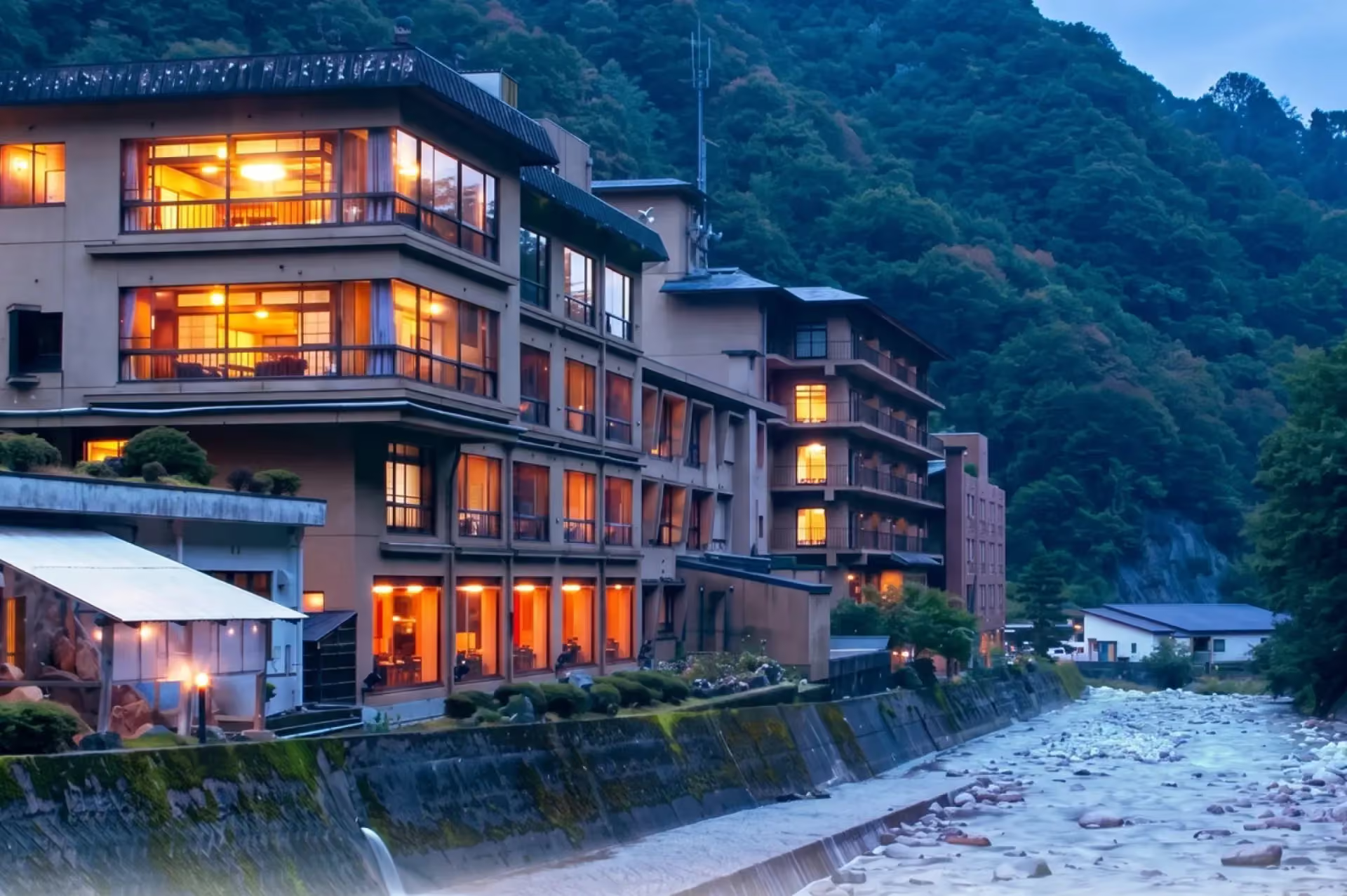
Iya Onsen is a hot spring in Iya Gorge in Miyoshi, Tokushima, and its biggest appeal is its location in a secluded canyon deep in the Shikoku mountains. Unlike flatland spa towns, this hot spring sits beyond steep ravines and mountain roads, and it is known for an open-air bath along the gorge that guests reach by descending to the valley floor. If you want to combine a hidden mountain gorge and a hot spring in one trip in Shikoku, this is one of the first places to consider.
For travelers, the key point is that Iya Onsen is not just a single bath, but also a gateway to the scenic attractions of the area, including Iya Gorge, Iya Kazurabashi, and Oboke and Koboke. It is easy to build a trip around soaking in an open-air bath overlooking a deep valley and then touring the bridge and gorge scenery. In this article, we organize Iya Onsen’s secluded location, the cable car to the valley-floor bath and gorge-side open-air bath, the highlights of Iya Kazurabashi and Oboke/Koboke, the qualities of the water and spring type, and access via the limited mountain bus routes, based on information from the Miyoshi City Tourism Association and others.
A secluded location in Iya Gorge
The charm of Iya Onsen lies less in the water itself than in the depth of the gorge where it sits. Iya Gorge is a canyon carved by the Iya River through the Shikoku mountains, with sheer cliffs and deep valleys stretching on and on. It is a landscape where hot springs and small settlements appear only after traveling far into the mountains, and it has long been described as a remote hidden region. Rather than a compact spa town on a plain, Iya is defined by scattered sights along the gorge.
This sense of remoteness is often told together with the legend of the Heike refugees who fled there. According to local tradition, members of the Taira clan, defeated in the Genpei War, hid in this deep valley to escape detection. This is only a local legend and not a confirmed historical fact, but standing there makes it easy to feel how isolated the gorge is and how such a story could arise. For the overall experience of a hot spring in nature, including outdoor baths and scenic views, see Outdoor Open-Air Baths and Onsen Experiences in Nature.
The gorge bath reached by cable car
One of the defining features of Iya Onsen is the open-air bath along the gorge, said to be reached by descending to the valley floor. In Iya Gorge, a steep cable car takes guests from the facility above the cliff down to the valley bath, and hotels such as Hotel Iya Onsen are well known for this experience. Soaking beside the Iya River at the bottom of a deep gorge is something unique to Iya and unlike anything you would find in a flatland hot spring area.
That said, these valley-floor open-air baths and cable cars are often used mainly by overnight guests, and whether day use is allowed, along with hours and fees, varies by facility and season. Because operating conditions and prices can change, be sure to check the latest official information if you plan to make the valley bath the centerpiece of your trip. Since it is an outdoor bath at the bottom of a gorge, weather and rising water levels can also affect availability.
Iya Kazurabashi
One of the signature sights of Iya Gorge is Iya Kazurabashi. This suspension bridge, woven from shirikuchi kazura vines, spans the Iya River in a primitive-looking style and is said to be designated as an Important Tangible Folk Cultural Property of Japan. Crossing it lets you see the valley through the gaps underfoot and feel the sway, turning the bridge itself into an experience of the gorge’s height and natural materials.
Kazurabashi is also often linked to the Heike refugee legend. According to the story, it was woven with vines and no nails or metal fittings so it could be cut down quickly if pursuers approached. This too is only a local legend and cannot be stated as the true origin. The bridge is said to be regularly rebuilt and maintained, and bridge fees, opening hours, and whether it can be crossed may change depending on the season and maintenance status, so it is wise to check official guidance before visiting.

The Koshien statue and Oboke-Koboke
Iya Gorge has other scenic spots besides Kazurabashi. One is the statue of Shoben Kozō, which stands on a cliff above the gorge and is known as a symbol of the dramatic Iya landscape. It is said to be linked to stories of travelers or children testing their courage by relieving themselves toward the valley, and it serves as a marker of the gorge’s height and ruggedness.
Another highlight is the Oboke and Koboke gorge area along the Yoshino River, where the Iya River flows in. This scenic area is known for its fast current and unusual rock formations, and it is also a base for river cruises and rafting. Iya Gorge itself and Oboke-Koboke are separate but neighboring valleys, and they are often visited together on an Iya trip. Because both are outdoor gorge landscapes, the impression changes with seasons such as fresh greenery and autumn leaves. Boat cruises and river activities are also affected by season, water levels, and weather, so if you plan to use them, check operations in advance.
Quick guide to the main sights
To help you plan around Iya Gorge, here is a simple overview of the main sights, their locations, features, and rough time needed. These are only general estimates, and availability for the gorge bath, Kazurabashi, boat cruises, and similar activities can change depending on the season, weather, and operating status.
| Sight | Location | Features | Approx. time |
|---|---|---|---|
| Valley-floor gorge bath | Below the cliffs of Iya Gorge | Said to be reached by cable car to the valley floor. Mainly for overnight guests; check official info | 30 min to 1 hour for bathing |
| Iya Kazurabashi | Along the Iya River | Suspension bridge woven from vines. Said to be an Important Tangible Folk Cultural Property | 30 min to 1 hour for crossing and walking |
| Shoben Kozō statue | Cliffs of Iya Gorge | A symbolic view of Iya Gorge overlooking the valley | 15 to 30 min |
| Oboke and Koboke | Along the Yoshino River | Gorge with strange rock formations and rapids. Base for boat cruises and river activities | 1 to 2 hours |
| The waters of Iya Onsen | Gorge-side facilities | Soft water said to be an alkaline simple sulfur spring | 1 to 2 hours for bathing and staying |
The water and spring type of Iya Onsen
The water at Iya Onsen is said to be an alkaline simple sulfur spring, and it is often described as having a soft feel on the skin. Although it contains sulfur, the overall dissolved components and character are said to be relatively mild, and it is usually introduced as a bath that is easy to enjoy rather than one with a strong white color or intense stimulation. For the general nature of sulfur springs, see What Is a Sulfur Spring?, and for the idea of a mild simple spring, see What Is a Simple Hot Spring?.
The soft water is sometimes called a beauty bath, but that is only a common nickname, and it should be understood as a description of the bathing feel rather than a promise of strong cosmetic effects. Experiences vary from person to person, and this article does not claim any specific health benefits. Because gentle water can still make you feel overheated if you stay too long, it is better to bathe in intervals and take breaks with water in between. The valley-floor open-air bath is outdoors and can have large temperature differences, so be careful not to get chilled too quickly after getting out.
The surest way to confirm the spring type is to read the hot spring analysis sheet posted at each facility. Spring names and components differ by source, and even within the name Iya Onsen, the exact notation may vary by facility. If you want to first understand the 10 major spring types and the structure of therapeutic hot springs, start with the Hot Spring Types Guide.
How to enjoy Iya
The best way to approach Iya is to think in two parts: staying at the hot spring, and touring the gorge sights. Because this is a remote area, the attractions are spread along the gorge and movement requires mountain roads. Rather than packing too much into one trip, it works better to focus on the valley-floor bath and Kazurabashi, then add Oboke-Koboke only within a manageable range. If you use the first day to get a feel for the gorge atmosphere at the hot spring and spend the second day visiting Kazurabashi and Oboke-Koboke, you will capture the core of Iya well.
If your main goal is the valley-floor bath, check in advance whether it is mainly for overnight guests and confirm the opening hours. Building it into an overnight stay is the most reliable option. If you are traveling as a day trip, confirm the day-use policy and time slot through the facility’s official information before you go, so you do not arrive and find that you cannot enter. If you are looking for Iya ryokan or day-use bathing facilities, we also provide a facility list and a search page so you can narrow things down by area or budget. If you want to compare Japan’s most famous hot spring areas more broadly, Top 10 Famous Hot Springs in Japan is also useful.
Access
When planning access to Iya Onsen, it is best to assume that mountain roads are the main route because of its remote location. By train, Oboke Station on the Dosan Line is considered one of the main gateways, and from there the usual route is by bus or car into Iya Gorge. However, buses to the Iya area are said to run infrequently, and some services operate only at limited times. If you go by car, you will still need to drive along narrow, winding mountain roads beside the gorge, so leave yourself plenty of time.
Because bus frequency, timetables, driving times, and road conditions change with the season and weather, be sure to check the latest official information from the Miyoshi City Tourism Association and others. This is especially important if you are using public transport, since you should secure the return schedule as well. In a place defined by a hidden gorge, it helps to plan with the understanding that the true value lies not in convenience but in the experience itself: the gorge scenery and the bath at the valley floor.
Frequently asked questions
What is the biggest feature of Iya Onsen?
Its biggest features are its secluded location in Iya Gorge, a deep canyon in the Shikoku mountains, and the open-air bath along the gorge that is said to be reached by cable car to the valley floor. Soaking beside the Iya River at the bottom of the steep gorge is what it is best known for. However, the valley bath and cable car are often used mainly by overnight guests, and whether day use is possible, as well as the fees, varies by facility and season, so always check official information.
What kind of spring water does Iya Onsen have?
It is said to be an alkaline simple sulfur spring, and is often described as soft on the skin. Although it contains sulfur, it is considered relatively mild and is often introduced as an easy bath to enjoy. It is sometimes called a beauty bath, but that should be understood as a description of the bathing feel, and experiences vary from person to person. The spring type should be confirmed by the hot spring analysis sheet posted at each facility.
What is Iya Kazurabashi?
It is a suspension bridge woven from shirikuchi kazura vines and one of the signature sights of Iya Gorge. It is said to be designated as an Important Tangible Folk Cultural Property of Japan. Linked to the Heike refugee legend, the bridge is said to have been made of vines so it could be cut down quickly if pursuers approached, but this remains only a local legend and not a confirmed origin. Fees and opening hours for crossing vary by season, so check official guidance.
How do I get to Iya Onsen?
Oboke Station on the Dosan Line is considered one of the main gateways, and from there the usual route is by bus or car into Iya Gorge. However, buses to Iya are said to run infrequently, and even by car you will travel narrow mountain roads along the gorge. Timetables and travel times vary with the season and weather, so check the latest official information from the Miyoshi City Tourism Association and others, and if you use public transport, make sure to confirm the return trip as well.
Can I visit the valley-floor open-air bath on a day trip?
Sometimes yes, but the valley-floor gorge bath is often mainly for overnight guests, and whether day use is allowed, along with hours and fees, differs by facility and season. If you want to be sure, it is safest to include it in an overnight stay. Before going on a day trip, be sure to check the facility’s official information about usage conditions.
Summary
Iya Onsen is a famous hot spring in Miyoshi, Tokushima, located in the hidden Iya Gorge carved into the Shikoku mountains. It is known for the gorge-side open-air bath said to be reached by cable car to the valley floor, and it also serves as a gateway to scenic spots such as Iya Kazurabashi, the Shoben Kozō rock statue, and Oboke-Koboke. The water is said to be an alkaline simple sulfur spring with a soft feel. The Heike refugee legend, the origin of Kazurabashi, cable car operations, bridge fees, and the limited access all involve either legend or changing conditions, so official information should be checked when planning.
If this is your first visit, focusing on the valley-floor bath and Kazurabashi, then adding Oboke-Koboke only within a comfortable range, will let you enjoy the hidden-gorge experience in a well-balanced way. Rather than convenience, the real value of this hot spring area lies in the gorge scenery and the bath at the valley floor, so plan ahead by checking transport frequency and usage conditions. If you want to understand the scientific background of the spring type as well, start with the Hot Spring Types Guide.
Sources
- Miyoshi City Tourism Association
- Nishiawa Tourism Bureau (Sora no Sato) (tourism information for Iya Gorge, Iya Kazurabashi, and Oboke-Koboke; check official sources for details)
- Tokushima Prefecture tourism site Awa Navi (tourism information for Tokushima Prefecture; check official sources for details)
- Ministry of the Environment, Guidelines for the Analysis of Mineral Springs (Revised in 2014)