Thematic GuidesFamous Japanese Hot Springs
Echigo-Yuzawa Onsen Guide: Snow Country Setting and Resort Fun
Explore Echigo-Yuzawa Onsen through two sides: its literary link as the setting of Kawabata’s Snow Country and its appeal as a snow resort easily reached from Tokyo by Joetsu Shinkansen. Learn access, skiing, station highlights, and spring quality.
Published: Jun 28, 2026
Thematic GuidesFamous Japanese Hot Springs
Echigo-Yuzawa Onsen Guide: Snow Country Setting and Resort Fun
Explore Echigo-Yuzawa Onsen through two sides: its literary link as the setting of Kawabata’s Snow Country and its appeal as a snow resort easily reached from Tokyo by Joetsu Shinkansen. Learn access, skiing, station highlights, and spring quality.
Published: Jun 28, 2026
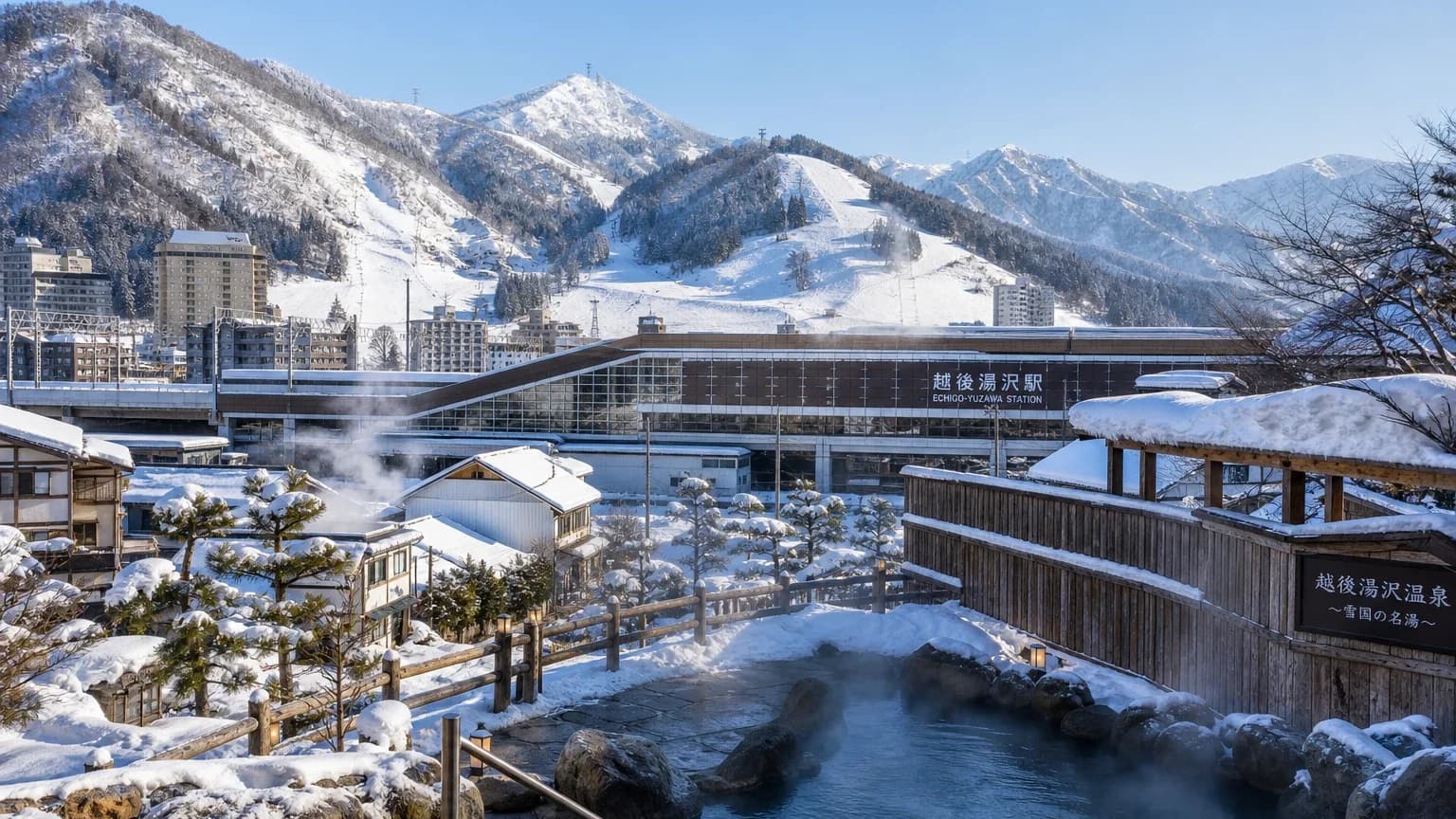
Echigo-Yuzawa Onsen is a hot spring area in Yuzawa, Minamiuonuma District, Niigata Prefecture, and it has two faces. One is its identity as a literary place, known as the setting of Yasunari Kawabata’s novel Snow Country. The other is its role as a snow resort that can be reached from Tokyo in a short time by the Joetsu Shinkansen, with many ski areas in the surrounding region.
In short, Echigo-Yuzawa Onsen is a rare hot spring destination that combines easy access with true snow-country atmosphere. Even though it sits in a heavy-snow region, a Shinkansen station is right next to the hot spring town, allowing visitors to enjoy both snowy scenery and proximity to the city. In this article, we organize its connection to Snow Country, access, how to enjoy skiing and the station, and how to read the spring quality, so you can understand the full picture before you go. Travel times by Shinkansen, as well as facility details, prices, and operating schedules, may change, so use them only as a guide and check the latest official information.
What Is Echigo-Yuzawa Onsen? A Snow Resort Depicted in Snow Country
Echigo-Yuzawa Onsen is a hot spring destination in the mountains of Niigata Prefecture, in a region known for heavy snowfall. In winter, deep snow covers the area, and that snowy landscape is one of its major attractions. It has long been known as a place of hot springs, but what spread its name nationwide was its connection with a classic work of modern Japanese literature.
Yasunari Kawabata’s novel Snow Country is said to be set in this Echigo-Yuzawa area. The famous opening line, “The train came out of the long tunnel into the snow country,” is widely known as a description of a train entering a snowy region. Kawabata is said to have stayed at the Takahan Ryokan hot spring inn and written Snow Country there. The room where he stayed is called the Kasumi room and is presented as a place with literary significance.
This kind of hot spring area becoming the setting of literature is not limited to Echigo-Yuzawa. Dogo with Natsume Soseki, and Kinosaki with Naoya Shiga are other examples of hot spring inns serving as places for writing and recovery in modern Japan. The background is summarized in our guide Writers and Hot Springs. Echigo-Yuzawa is another hot spring area where the character of a snowy region is closely tied to literature.
How to Get to Echigo-Yuzawa Onsen
One of Echigo-Yuzawa Onsen’s biggest strengths is how easy it is to reach. The nearest station is Echigo-Yuzawa Station on the Joetsu Shinkansen, and Tokyo Station is roughly 75 to 85 minutes away. For a hot spring destination in a heavy-snow area, this is unusually close, making it easier to visit from the Tokyo metropolitan area on a day trip or overnight stay than many other snowy hot spring destinations.
| Departure | Main Route | Approximate Travel Time |
|---|---|---|
| Tokyo | Joetsu Shinkansen to Echigo-Yuzawa Station | About 75 to 85 minutes |
| Echigo-Yuzawa Station | Some parts of the hot spring town are within walking distance | A few minutes to varying by area |
| Each ski area | Shuttle buses or transfers from the station | Varies by facility and season |
These times are only estimates and vary depending on train type and time of day. In winter, schedules may be disrupted by snow and weather, so it is wise to check operating conditions in advance on official sources. Some parts of the hot spring town are close to the station, but depending on the inn or ski area, shuttle buses or local buses may be necessary. It is best to choose your transportation according to the guidance of your accommodation.
How to Enjoy It as a Ski and Snow Resort
Many ski areas are scattered around Echigo-Yuzawa. Among them, GALA Yuzawa is especially well known as a ski area directly connected to the station, making it one of the symbols of Echigo-Yuzawa as a snow resort. Being able to arrive by Shinkansen and head straight to the slopes is a major advantage unique to this hot spring destination.
A classic way to spend time here is to ski or snowboard and then warm up in a hot spring. That is a standard snow-resort experience. However, slope opening periods, lift fees, and access methods differ by facility and season, so be sure to check each ski area’s official information before using them.
If you visit in the snowy season, one of the pleasures is a snow-viewing bath, where you soak while looking at the snowy landscape. The enjoyment and precautions for snow-viewing baths are covered in more detail in Snow-Viewing Baths. We also summarize how to choose a winter-strong hot spring destination like Echigo-Yuzawa in How to Choose Snow-Viewing Hot Spring Destinations, which is helpful when comparing travel options.
Enjoying Echigo-Yuzawa Station and Ponshukan
When talking about Echigo-Yuzawa Onsen, one thing you cannot leave out is how rich Echigo-Yuzawa Station itself is. Inside the station is a facility called Ponshukan, which is popular as a place where visitors can sample the charms of Niigata’s rice and sake culture all at once.
Ponshukan is especially known for its tasting corner, where you can try many local sake brands from Niigata in small amounts. In addition to experiencing sake culture from one of Japan’s major rice-producing regions, you will also find local specialties such as hegi soba and shops selling food from the rice-growing heartland. Being able to spend time at the station while waiting for the Shinkansen, or before and after visiting the hot springs, is one of the unique pleasures of Echigo-Yuzawa, where the station and hot spring town are so close.
Please note that opening hours, tasting fees, and available offerings may change, so check official information before your visit. Along with snow viewing and skiing, it is worth including time to enjoy the food and sake of the snowy region in your travel plan.
How to Read the Spring Quality of Echigo-Yuzawa Onsen
The spring quality of Echigo-Yuzawa Onsen differs depending on the source spring. It is commonly introduced as simple hot spring water or sodium chloride spring, but since each inn and source has different mineral components, it is not appropriate to make a blanket statement such as “this is the spring quality of Echigo-Yuzawa.”
Spring quality is determined by the type and amount of dissolved minerals in the water. Japan’s Ministry of the Environment has guidelines for analyzing mineral springs that define how therapeutic springs are classified and named. The hot spring analysis sheet posted in the changing area or bathhouse of a facility lists the spring quality of that source. When you visit Echigo-Yuzawa, checking these notices lets you know exactly what kind of water you are soaking in.
For a systematic guide to the characteristics and distinctions of each spring quality, and what each spring name means, see A Beginner’s Guide to Hot Spring Water Types. Rather than judging benefits only by the impression of a spring name, using the analysis sheet as a clue and appreciating the water itself is the basic way to enjoy hot springs more deeply.
Choosing Echigo-Yuzawa for Literature and Access
Echigo-Yuzawa Onsen’s character becomes easier to understand when viewed through two axes: a literary setting and an accessible snow resort. It has the depth to satisfy people who want to feel the literary atmosphere of a place connected to Snow Country, as well as those who want to enjoy mountains and hot springs with minimal effort by Shinkansen.
| Highlight | Location / Feature | Approximate Use |
|---|---|---|
| Kasumi room at Takahan Ryokan | A room in an inn said to be where Kawabata wrote Snow Country | Follow the inn’s guidance. Check official details |
| Nearby ski areas such as GALA Yuzawa | A snow resort known for ski areas accessible directly from the station | Opening periods and prices vary by facility and season |
| Ponshukan at Echigo-Yuzawa Station | Sake tasting, hegi soba, and food from the rice-growing region | Inside the station. Check opening hours officially |
| Snow-viewing baths | Winter bathing while looking at snowy scenery | Mainly during snowy season. Weather may affect access |
If you want to understand how Echigo-Yuzawa compares with famous hot springs around Japan, read Top 10 Famous Hot Springs in Japan. Comparing it with other hot spring destinations makes its strengths clearer. The combination of literature, access, and snow-country atmosphere is the reason to choose Echigo-Yuzawa Onsen.
Frequently Asked Questions
Is Echigo-Yuzawa Onsen the setting of Yasunari Kawabata’s Snow Country?
Echigo-Yuzawa is known as the setting of Yasunari Kawabata’s novel Snow Country. The famous opening line, “The train came out of the long tunnel into the snow country,” is widely recognized, and Kawabata is said to have stayed at Takahan Ryokan while writing the work. The room where he stayed is called the Kasumi room. The connection between hot springs and literature is also covered in Writers and Hot Springs.
How long does it take to get to Echigo-Yuzawa Onsen from Tokyo?
Using the Joetsu Shinkansen, it takes about 75 to 85 minutes from Tokyo Station to Echigo-Yuzawa Station. For a hot spring destination in a heavy-snow region, access is very good, and that is one reason it is easy to visit from the Tokyo area. Travel time varies depending on train type and time of day, and schedules may be disrupted by weather in winter, so please check official operating information.
Can I enjoy both skiing and hot springs in Echigo-Yuzawa?
Yes. There are several ski areas in the surrounding region, and GALA Yuzawa is especially known as a ski area directly connected to the station. Skiing or snowboarding followed by warming up in a hot spring is a classic way to spend the day. Since slope operating periods and fees vary by facility and season, please check each ski area’s official information.
What is Ponshukan?
It is a facility inside Echigo-Yuzawa Station, featuring a tasting corner where you can sample local sake from Niigata in small amounts, along with shops selling local specialties such as hegi soba and food from the rice-growing region. It is popular as a place to experience the appeal of Niigata, a famous region for rice and sake. Opening hours and tasting fees may change, so checking official information is recommended.
What is the spring quality of Echigo-Yuzawa Onsen?
It varies by source spring, and is generally introduced as simple hot spring water or sodium chloride spring, but because the components differ by inn and source, there is no single answer. The most reliable way is to check the spring quality name on the hot spring analysis sheet posted in the changing area or bathhouse. The differences between spring types are explained in detail in A Beginner’s Guide to Hot Spring Water Types.
Conclusion
Echigo-Yuzawa Onsen is a literary destination known as the setting of Yasunari Kawabata’s Snow Country, and at the same time it is a snow resort that can be reached from Tokyo in a short time by the Joetsu Shinkansen. Even in a heavy-snow region, it offers excellent access, combining snowy scenery with proximity to the city, which is its greatest defining feature.
There is a wide range of ways to enjoy it: inns connected to literature, ski areas directly linked to the station, Ponshukan where you can taste Niigata’s sake and food, and hot springs where you can admire snowy scenery. Since the spring quality differs by source spring, it is best to check the analysis sheet on site. Shinkansen travel times and ski area information can change, so while planning, be sure to confirm official information and build a trip that lets you enjoy both the literature and the resort atmosphere of the snowy country.
Sources
- Yuzawa Town Tourism Association
- Niigata Tourism Navi (Niigata Prefectural Tourism Association)
- Ministry of the Environment, Japan: Guidelines for Analysis of Mineral Springs (Revised in 2014)
Hotels & Facilities in This Onsen Town


Japan's Finest Onsen & Sauna, 64 places — a paid web magazine
A trip to Japan you may take once. Which onsen and sauna will make it the best experience?
The more you research, the longer the list gets, and the less you know which ones are truly good. One editor traveled all of Japan, bathing in onsen and sauna, and kept only the 64 that stayed with him — one full spread each, with what he felt there and why he would go back.
One of them opens free.